Sunday, July 24, 2016

Buying a Beer In Kuala Lumpur

    At the end of most days I enjoyed the pleasure of a cold beer. The heat and humidity of the day would fade and I would rest, away from the dust of the street and the rigours of an idle life. Here in the quiet of a local restaurant, I could sit and watch life around me unfolding as it did, day in and day out, whether I was there or not. I took this time out from sight seeing or exploring the city or countryside and found some cool, dark place to sit and enjoy one or two cold drinks. Sometimes, when I was in a city of some size I would change my usual clothes, don something that was as close to respectable as I could muster and would visit some up-scale hotel. There, amid the air conditioning, the potted plants and the piped in music I would sit and watch the tourists coming and going in their crisp, clean clothes. I could only imagine the lives of the men, all shaved and cologned and the women perfumed, not a hair out of place and wonder what it was like to have such money to afford this existence. I knew that I could watch it but that I would never live it. I lived in hostels and cheap hotels that had toilets down the hall. I washed my clothes in the sink at night and ate from food stalls, flirting with dysentery with each bite. A cold sore from a dirty glass was the worst I ever had to bear. I count myself lucky. But here in the lap of luxury I could only be amazed as I was treated with deference by waiters dressed in stylized local costumes who would bow at the waist, take my order and accept my money. They were aware of my charade. I looked the life I led even when dressed to try and disguise it. After an hour of this I would have had enough and would head back out to the heat and the dusty streets that were my part of the city.
   It was nice, upon occasion, to be treated as if I belonged and not as if I were sent as some cosmic test upon the owner or waiter of some back street food stall. At these places, where I more often than not would go in the late afternoon to quaff a cold one I seemed to be a phenomenon encountered for the first time. I was a white person, a white person who sat at a table and appeared to want something. Deference was not on the mind of those who were about to assume some sort of responsibility for my being there. This scene played out all over South East Asia and was played out with little variation regardless of the country or the number of white tourists in the vicinity. So long as I chose a place to have a drink that was a couple of blocks away from the main tourist area it ran true to form, as though there had been a script handed out for just such an occasion. 
    There were two main brands of beer that I remember, Tiger and Anchor and they came in two different size bottles, large and small. Every place had at least these two different brands and had the two different sizes. I, for whatever reason happened to favour Anchor brand beer and for economy of time if not cash would order the large size. The script was, as I said, always the same. The location and ambience of the place were the only variables but these didn’t matter. 
    I would see a place on my route back to the hostel/cheap hotel and decide on a beer. I’d walk in through the open door to the gloom of a small room lit only with the light from the window and a florescent tube at the rear of the establishment where a small group of men were engaged in a conversation. All but me were oriental, all but me spoke Chinese. I chose a table by the window so I could watch the street and waited. The conversation, which had been in full swing when I entered, now stopped and the only sounds were those from the street and the hum of the cooler full of beer. If I had looked I would have seen all heads turned, all eyes on me and then one short, staccato burst of Chinese would be spoken. There would be a reply or two and again silence. More words and then in the silence I would hear the slap, slap of a pair of thongs coming my way. A slight, middle aged Chinese man would appear wearing the national, cheap eatery uniform, a white undershirt called a singlet, a baggy pair of pants too short by correct sartorial standards, the thongs and a cigarette held in the lips and bleeding smoke into one eye. And the play would begin….
“What you want?” This was as much an accusation as a question as though I were there to cause some sort of, as yet undiscovered mischief.
“I’d like a beer please, a large Anchor beer.” I held my hands up indicating the size of a large bottle while I carefully enunciated ‘beer’, aware of the language differences.
“You want beer?” It was again more of an accusation than a question. There was a murmur from the back of the room and then once more, silence.
“Yes please, an Anchor beer,” my hands rose, “a large Anchor beer.” and now were held between us, shaking back and forth slightly to indicate the size of the bottle. 
“What kind of beer you want?” Now the tone changed slightly from pure accusation to part challenge as though if I ordered the wrong type of beer he’d have caught me dead to rights in some sort of conspiracy.
“I’d like an Anchor beer please, a large Anchor beer.” I glanced at the cooler. 
“You want Anchor beer?” His tone was now close to hostile as though the whole plot, the whole reason for my being there, was about to be revealed.
“Yes, a large Anchor beer.” My one hand held at the approximate height above the table my other indicating a drinking motion. 
“What size Anchor beer you want? You want large Anchor beer or you want small Anchor beer?” 
I thought I’d better get this right as it would be my last chance to get what I was after. One wrong word and I’d end up with nothing or a small coke. “I’d like a large beer, a large Anchor beer please.” My hands once more were held to indicate a large bottle. The group at the back were so engrossed in the play that a cigarette burnt down to the fingers of one man and a flurry of words and activity suddenly erupted. My waiter turned and for a moment I thought that I was about to be out of luck at this place but he once again resumed the script.
“You want large beer?” He forgot to say the brand. Did this mean that we’d have to begin the whole thing over again? 
“Yes please, a large Anchor beer.” This was the pivotal moment, it all was about to happen or was going to fall apart and I’d be told that there was no beer even as the cooler hummed away in the distance. 
“Large Anchor beer?” For the first time I thought I might be winning, it was a statement that verged on being a question. 
“Yes.” It was all in his hands now. Would I drink or move on, parched, to the next place I could find? He looked at me as though trying to decide what to do or if he had heard me correctly and then he turned and walked away.
    The conversation at the back of the room once again began in earnest. My waiter spoke with the group, all looked at me, a man spoke and gestured, I smiled. Then he walked to the cooler and took out a bottle of the beer I had been asking for. A glass was found, one of those small, firm glasses usually seen in the bathrooms of hotels and both would be brought to my table and laid before me. An opener was produced and the bottle uncapped. I tilted the bottle, already laden with dew in the humidity of the afternoon and poured a glass full as the waiter retreated and for the moment I could be ignored if not forgotten. 
    In the street outside nothing of consequence took place other than the daily routine of a world that was fascinating for me because of the unfathomable secrets that it held. If I lived there for the rest of my that life I felt I’d die an old man still trying to figure out the mysteries of the place. 
    Some times as the sun would begin to set and as my drink was about to finish I would hear the sounds of the kitchen. Pots and pans would be set heavily down and something would be tossed into a heated wok and the hissing and spluttering of cooking would remind me that I hadn’t eaten yet and so I would begin act two of the play. 
    A look at the back of the room revealed a menu in two or three languages hung on the wall. Usually I could figure out what was being offered and so would decide on some special of the day. After some studious ignoring I would finally get the attention of the same benighted man that had first been forced to deal with me. He would slowly disengage himself from the rest of the group and make his way to my table. 
    “What you want?” He was as eager to serve as always. I would point to the menu and ask for the meal of my choice. He would turn to gaze at the board as though it were the first time that he had ever realized it was there. He paused as if contemplating some greater reality and then turned again to me. “No got food!” Dishes clattered beyond the beaded curtain that separated the two rooms. I would begin to protest but a wave of the hand and another “No got food!” would dismiss me and he would turn to rejoin the group. I was left standing in the middle of the room, the smells of spiced chicken and sesame noodles wafting on the air and I would turn to leave, defeated at last. Just then an old man bearing a tray of food would come through the curtain and into the room. Some, if not all of the men would turn to look my way, hoping perhaps that I was gone or at least dull enough to not realize what was on the tray. I’d look and smile and all would turn again to the task at hand and I would be forgotten. 
    The street corners were occupied with men selling chicken satay cooked over charcoal fires or roti makers tossing and stretching the dough in the Asian way and so tonight I would eat standing up on a darkened corner of a side street in Kuala Lumpur. 

1973.

Friday, July 22, 2016

 The second in a series written for the newsletter of the Upper Ottawa Valley Genealogical Group. Published in a slightly shorter form, July, 2016.

The Hesitant Beginning of the Pembroke Collegiate Institute.


It all began with an innocuous little item in the April 6th, 1922 edition of the  Pembroke Observer,  “School Problems Were Discussed, Committee to Locate High School Site.” A committee was indeed formed to “go into the matter of locating a site for a New High School.”  With this seemingly simple task began three years of debate, fighting, government intervention and more newspaper ink than had ever been used on one story in the history of the paper.
The old high school on Isabella Street was overcrowded and the new head of the fire department, Chief Blackler had inspected the building and essentially called it a fire trap that was not suitable as a school without major repairs. Something had to be done.
It all seemed so easy. By the first of June two sites had been selected, one at the corner of Peter and Herbert Streets on a piece of land that was owned by the Public School board and was about to be used by them for the proposed new East Ward School. However they were willing to sell off three acres at a reasonable cost to be used to build the high school.
The other was at the end of Moffat Street on the parcel of land known as Moffat’s Point. Neither was deemed acceptable.
For a year things sat at an impasse. Meetings were held but nothing of note reached the press until the first day of school in the fall of 1923 when there were more students than there were places to put them. A temporary and  wholly unsuitable arrangement was made to have some students attend classes at the town hall but a  week after this began Trustee, Mrs. Gus. Schroeder, visited the temporary school and declared it a “tragedy” that was fair to neither the pupils, their parents or the teachers. Classes were separated by thin cotton curtains strung on wires, there were no suitable washroom facilities available and the noise of multiple lessons being taught at the same time was not conducive to learning.
An option had been taken out on the O’Kelly Park site for $20,000 but when this price was accepted the nitpicking began and at the next council meeting the O’Kelly site was rejected and so as the season turned to winter the situation remained as it had been in the spring of a year and a half ago.
While all the debating and the bickering was going on over the high school the East Ward Public School had been proposed, designed and built and was, as 1924 began, about to be opened to the students who had been in the old school on the corner of William and Alfred Streets. This old school that had been in too poor a condition to fix was now going to be partially taken over by the students of the high school as their new temporary classrooms.
By March the town had been visited by a high school inspector who had handed into the board a report that “is said to be a very black one.”  An ultimatum was given, if a new high school building wasn’t soon begun there would be a withholding of all high school grants. Then the principal quit. Mr. U.J. Flach, feeling he did not have the confidence of his staff as teachers were threatening to resign due to the stress of overcrowding, handed in his resignation and it was accepted by the board. The Premier of Ontario, had by this time, heard of the Pembroke situation and at the request of the local Board of Education he sent a representative here to meet with the board.
Six sites were reviewed, and although it was deemed to be too far in the east end the board eventually asked the town for $4,500 to purchase the W.R. White property on the southeast corner of Cecilia and Esther Streets. This, along with the O’Kelly site were the only two deemed suitable by the government but now the council vetoed the request with the excuse that the cost of leveling the site and installing water and sewer lines would be too costly. Now a new location was put forward, the Miller-Munro site and although this never seemed to get serious consideration it was, from time to time brought up as an alternative site to whatever was being proposed at the moment.
September opened with two hundred and forty boys and girls registering in the high school. A week after the opening bell was rung the board was once again debating the merits of different sites.  One sticking point was the policy of the provincial government that a high school needed at least three acres of land to be situated on. Every suitable site in town that had been suggested was less than this minimum and so a delegation was formed to meet with the Minister of Education in Toronto to see if this rule could be bent a little, given the local circumstances. However Premiere Ferguson said there was little he could do and suggested that the town leave off the matter of a new school for a year or two or to perhaps renovate and enlarge the old school by expropriating adjacent homes.
Meanwhile the new principal, Mr. Willoughby, met with the board to discuss his school. He told of a lack of proper equipment for teaching chemistry, of overcrowded classrooms and conditions that “startled his hearers.”  of having only one working typewriter out of eleven in the commercial class and of teenage students attending the east ward annex having to sit in seats meant for junior pupils.
The year closed with no movement towards a solution of the school question and by the first meeting of the board in February of 1925 it was hoped that this would be the year of success. But instead the first meeting ended in disarray with members hurling insults and accusations. The next session again met without success at deciding on a location but did throw in two more properties to consider. One was the Hale-Scott property on Pembroke Street east but this was eventually vetoed due to the fact it would be located opposite a factory, the Superior Electric Company. The other, mentioned for the first time was the Mackie property at the other end of the main street near the corner of Christie Street. This was thought to be not an appropriate site as it was on the main street and the government wanted schools to be located away from busy thoroughfares. A vote was held to try and select a property and in the end all five properties were voted down.
Meanwhile the fire department was looking into taking over the old high school to be used as a fire hall but when this was found to be economically unfeasible the board once again began looking into expropriating the surrounding properties and fixing the old place up.
Then around the first of April, 1925, after two years of debate a property was decided upon. The Mackie property was purchased, the old school was sold to the Separate School Board, by the end of the month architect's plans were being inspected and one was selected. By the end of July all the contracts had been awarded and by mid August excavation work had begun. Then, as work was progressing, some of the trustees, while strolling past the construction site, thought it would look better if it were set back another ten feet. And so a new excavation was begun.Then as it progressed it uncovered an underground stream that ran through the property,  went under McGaughey’s corner eventually finding an outlet in the hill behind the library. This new development required building a cofferdam around part of the excavation, adding time and cost to the building of the foundation.And so a new excavation was begun adding time and cost to the building of the foundation but it was built and the school would be open it time for the new academic year in September of 1926.
The school year of 1925/26 ended and on the evening of July 2nd the students of the old high school met on the grounds to reminisce around a bonfire. Wet wood forced them into the building where they rounded up the High School Orchestra and held an impromptu dance. Old students and teachers from years gone by dropped in to chat and at midnight a farewell cheer was raised to the old school, the National Anthem was sung and the old building ended its career as a public high school.
On September the seventh the new school welcomed its first students. Later in the month, on September twenty fourth the official opening was held with a host of dignitaries attending the event including the Premier of the province who was undoubtedly happy to be hearing the last of Pembroke and its high school woes.
During that year and in the years that followed the high school auditorium became the venue for plays, talks and meetings. The students began writing a weekly column in the Standard-Observer and that first spring saw the beginning of a long tradition with the printing of the first edition of the Nexus.

Now with the high school problem solved the town council could turn its attention to that other perennial problem that seemed to defy a solution. Where to relocate the town offices?

Friday, July 8, 2016

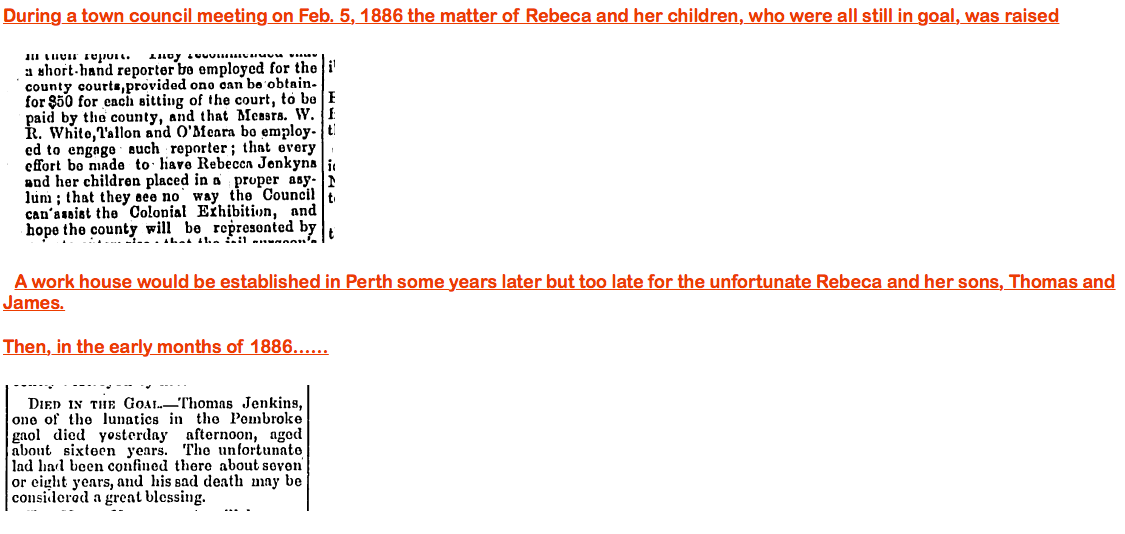
The Sad Case of Rebecca Jenkins

To see a clearer copy click on each of the cells. 


 (addendum - Thomas Jenkins died on May 21, 1886)

Thursday, June 16, 2016

This the first in a series of articles written for the Upper Ottawa Valley Genealogy Group newsletter. Published in April, 2016

The Overall League

   It was spring,1920 and the season was ushered in with the notice that the yearly price of gasoline had been set at forty five cents a gallon and by the noticeable increase in Mr. Findley Watt's business. Mr. Watt was the district agent for motor vehicle licences and car owners were busy getting their Grey-Dorts and Hupmobiles out of winter storage and ready for another season of driving and of course with this came the first accident of the year when young William Anderson drove his father's motorcycle into Dr. Mulvihill's car.
The town seemed to be not only prospering but on the verge even greater prosperity. The British firm of Maguire, Paterson and Palmer had begun work on their new match factory near Moffat's Crossing and there was plenty of work for men who had returned home from the lumber camps. Plans were underway to construct a new East Ward public school and to establish a new park in Girouxville in the west end of town, a park that would eventually become known as Riverside Park.
The Local Council of Women were keeping an ever watchful eye on the youth and to this noble end they had persuaded the movie theatres to stop running serials and for the police to be more diligent in ringing the curfew bell in the evening. They had also established a committee to look into having a memorial erected to the memory of the fallen soldiers of the Great War and were instrumental in seeing this project through to its completion some years later.
There were two new restaurants on the main street. Mr. Fong Deen was opening the Oriental Cafe at 55 Pembroke Street west and farther up the street at 97 Pembroke Street west Mr. Willie Hong was converting his hand laundry business into what would soon be the Crown Cafe. At the block at the bridge the cafe, ice cream, confectionery and fancy bakery business of Brunette & Bergerron had just celebrated the opening of an addition to their business at 21 Pembroke Street west by having an evening of music by Van Gene's Orchestra in their new annex at 23 Pembroke Street west.
Earlier in the year the town had had yet another major fire on the main street when the Heenan Block, that row of buildings running from Prince Street eastward to Delahey's Department Store (now Bob's Music) caught fire and burned to the ground. But by early spring all the displaced businesses had found new homes, the cleanup of the old buildings had begun and even this near disaster couldn't put a damper on the mood of the town.
The newspapers in those heady days were filled with advertisements from all the major stores of the town and there seemed to be perpetual sales throughout the business section. Duff's Clothing had just moved to the corner of Pembroke and Moffat Streets, two doors east from their old location at 218 Pembroke Street and were having a big introductory sale. Eaton's Bootery had taken over Duff’s old store and they too were having an introductory sale to their line of boots and shoes. Up at the north end of Mackay Street Mr. Charles Shore who had just taken over the clothing store "next to Cecile's Hotel" from Mr. M. Addleman was having an "I Want To Get Acquainted" sale.         
Men's suits were going for anywhere from $28.75 at Duffs, to $35 next door at The Oak Hall Men's Wear to $46.50 at Mr. Shore's new store. For the ladies, Delahey's was selling their new "Modes For Spring" that "pay tribute to womankind" with ensembles ranging in price from $20 to $65. Those essential accessories, gloves and scarves, were selling for up to three dollars and ladies hosiery went for anywhere from seventy five cents to three dollars a pair.
The Ladies Exclusive (later known as Doran's Ladies Wear) had a range of dresses costing anywhere from $15 all the way up to $75 as well as hats and accessories. Their ad stated "We can save you money and railway fare" underlining a problem that was as relevant then as it is now, out of town shopping.
It was not uncommon for local shoppers, especially the better heeled, to travel by train to the city to do their shopping, even at times, grocery shopping. It was estimated by the merchants that each year a hundred thousand dollars was spent on shopping trips to Ottawa and on catalogue shopping, money that could have been better used to support the local business community. To try and curtail this trend the merchants, allied with both newspapers, launched a "Buy Local" campaign, urging shoppers to support their local businesses saying "If You Buy Out of Town…..What Will Become of Our Town."
History now tells us that the average Canadian man earned just under one thousand dollars a year in 1920. In 1923, the carpenters in town went on strike until they achieved a wage of sixty-five cents an hour and in 1927 the town council decided to raise the wages of their workers to a flat thirty-five cents an hour eliciting howls of outrage from local industries. These industries, such as the match factory, the Steel Equipment and Superior Electric claimed to pay a top wage of thirty-three cents an hour but when pressed acknowledged that many were paid less than this and the Shook Mills was paying some workers as low as twenty-five cents an hour.
Into this mix of low wages and high clothing costs came the boys of the Pembroke High School on Isabella Street. Already used to wearing denim jeans after school they now formed an "Overall League" and took to only wearing khaki coloured suits of this material as a protest against the high cost of new clothes. The boys were said to look quite "correct" in their new attire which they kept clean and neatly pressed  and it was said that at a distance it was impossible to tell if a fellow was or was not wearing overalls. The fad spread until it reached the Copeland Hotel where many of the boarders at that  establishment, professionals and otherwise, signed a compact to discard their conventional business attire and don overalls exclusively. They not only signed the compact but proposed to levy a fine on anyone who had signed the pledge and was found to be wearing conventional clothing.
As the fad spread clothing stores had quite an extensive run on overalls and workmen's smocks and their windows now featured these items, replacing the pricey suits and natty ties of previous weeks. Their ads in the newspapers too reflected this shift in sensibilities. Previous to this if overalls were mentioned at all they were regulated to the small print at the bottom of an ad along with socks, underwear and handkerchiefs. Now they were the featured item. Delahey's had a full ad featuring drawings of young men looking very fashionable in their one dollar and ninety eight cent overalls and dollar twenty-five work shirts.  Fenton & Smith's went more traditional using a drawing of a railroad man standing beside the driving wheel of a locomotive and wielding a tool as a conductor stands off to the side looking at his watch and the logo "Kitchen's Railroad Signal Overalls" between them. Prices here ranged from a dollar seventy-five to three and a quarter for overalls and workmen's shirts could be had for as low as a dollar.
The Oak Hall, known for it's fine line of gentlemen's clothing, deigned to advertise they had "Outfits for all classes" and while they never did sell overalls they did have “well made working pants in grey stripes.”
Even that venerable old shop for men, Watters & Bodell where fine materials, bespoke suits and Borsalino hats were were the order of the day, they too devoted a goodly portion of an ad to work shirts, overalls and smocks, shop coats, working suspenders, handkerchiefs and "Kant Krack Collars."
Some people felt that as well meaning as this protest or fad was all it did was to drive up the cost “of the very clothing that the poor working man needed for his daily labours.” They felt it would have been better to have had an "Old Clothes League," to have worn out all the old clothing and shoes rather than put more money into the very pockets of the merchants they were protesting against.
In the end it all died out rather quietly and by the latter part of April nothing more was heard of the Overall League. The men’s shops went back to advertising their usual items and perhaps the students turned their attention to an upcoming feature at the Grand Opera House, "The Eyes Of Youth" starring Clara Kimball Young or perhaps to the Casino Theatre where Alice Brady starred in "Marie Ltd." or later in the week when Bessie Basercalles played in "Tangled Threads."
That was almost the end of overalls playing any role in the news of Pembroke except for a short period mid-decade when Schultz’s Mens Wear declared an overall week and advertised a brand of overalls and jackets that offered cinder proof collars.
But then, on a warm September day in 1929 a pair of overalls again made the news. A young woman strolled up the main street wearing a pair of overalls but not just any overalls. These were a pair of bright pink overalls worn over a knitted silk shirt. On her feet she wore pink socks and a pair of “high heeled slippers” and this was all topped off with a jaunty sailors cap and a generous dab of pink rouge on each cheek. Cars zigzaged up the street and turned to follow the young woman and her somewhat bashful escort. Pedestrians risked walking into lamp posts as they stared at the young couple and a gaggle of children trailed along behind them.
Where they came from and where they went wasn’t reported but for a brief moment this “young lass in a vivid suit” brightened staid old Pembroke and gave it something to talk about.

Monday, February 17, 2014

The Feral Cat Project of the Heart

We are cat people, my partner and myself. We cohabitate with two now, have each had our own in the past before we met, have more photos of our cats than of our our respective children and grandchildren combined. We talk about them over restaurant meals the way other people talk about their infant children, we worry about them when they’re out or they’re late coming home and like doting pet owners everywhere we’ll sit still longer than we planned, longer than is comfortable simply because a cat is resting on our lap. We’re cat people, not to say that if we had a dog it wouldn’t be given the same lavish attention but we prefer that independant, “what, me give a shit” attitude that cats embody. A psychological failing no doubt but it is ours and we embrace it.
  Several years ago while out shooting photos I came across a crudely made cat shelter and a dozen or so ill fed cats who scattered as I approached. I took a few pictures, moved on and later that evening mentioned my find to my partner. The die was cast. The next day she went off to investigate with a bag of food and a heart filled with compassion. We’ve been there ever since.
   It started off innocently enough, we said we’d feed them upon occasion when we had some extra cat food or rejects from our two spoiled fellows. We’d prop up the shelter so it was a bit more weather resistant and put an old tarp we had over the feeding area so the food was sheltered from the rain. That was all. Sure. But then the inevitable happened. As we set off into the trees and the jumble of urban forest where they lived they would be waiting for us on the path. Or as we walked along they would emerge from the tall grass and weeds, would run ahead leaping for joy and rolling about in the ecstasy of anticipation. They ran away less, milled about as we poured out food and occasionally we’d be able to steal a pet or two as they ate.
   Their numbers varied but we seemed to have a basic group of about a dozen and some we’d see for a while but then disappear until I happened to spy them sitting outside the take out window of a nearby fast food joint, looking up expectantly as if waiting on their order.
    Somehow they all ended up with names, we’d talk about individual personalities and traits and who we’d bring home if we had the opportunity. The bringing one home idea was one of those things you talk about without ever thinking it’s going to be real. Like winning the big money lottery. We were already crazy cat people who fed a bunch of ferals, we didn’t want to become the crazy cat people next door. So every day or every other day we’d make the treck to the shelter in the woods with food, sometimes just to feed and leave and sometimes to stay and sit and watch them eat and loll about afterwards as they washed themselves and sorted out the hierarchy.
   Not all was sweetness and light however. Twice someone burnt out the shelter, destroying all the little comforts we had made but each time we rebuilt an even finer habitat, more waterproof, more insulated, more comfortable. People would steal the feeding dishes and the food we left and at times we know someone had been unkind to them as they’d be skittish as we approached and it would take time until they were comfortable with people again. We had kittens, little balls of fur we bought kitten food for as they were weaned and even though they gave us great joy to see them grow and thrive we were glad to see a group of women gather them up and give them homes.

  So through days of sunshine and warmth, days of miserable rain or days of knee deep snow we go off to feed the girls and get a little bit of sunshine to our hearts on even the most inhospitable day.


Friday, August 12, 2011


We feed birds. In the winter we have a bird feeder that we fill with seeds, grains, cracked corn and things the bird books say birds love yet never seem to eat. It provides us with a little joy at seeing the avian life come to our back yard to dine and live in this most harsh of seasons.
In the summer we still put out food but as most of the birds we have seem to prefer to feed on the ground, the feeder, although filled with food, is mostly ignored except for the bits that have fallen to the ground where the doves, the wrens, the thrushes, the yellow thrushes we call canaries, blue jays and cardinals all gather. And we have cats. Two of them. One, the alpha male concerns himself with maintaining the integrity of his territory, patrolling the yards of the neighbourhood to keep other cats in their places. He also doesn't see very well so hunting for him is an exercise in futility. Something he has figured out. The other one, although well fed, overly fed in fact, is the typical hunter/killer feline. When something in the yard moves he goes into the hunter/killer cat pose, low crouch, tail twitching, slinking towards the prey in short bursts of stealth. Luckily for the birds his girth means he is not the most athletic of animals and so we have only once seen a victim of his skill. Both mice and moles seem to be an easier catch as they show up mornings on our lawn, stiff and inert, waiting for the crows to come and carry them off.
We have morning doves that perch on the wires or the fence and survey the territory, coming in to feed or strut and then taking off with that squeaky wing sound as though they are in need of a good oiling. They are attractive birds, feminine looking as though they all are the pretty but vacuous members of the bird world.
As I said, we like these birds, wish them no harm but know that the presence of the hunter/killer cat no matter what his skill level, is a threat to their lives. So for the summer we put the food inside the fence that surrounds our swimming pool. This allows them safe eating on the ground, safe from the cats and allows the social, hierarchical fights of the bird world to be carried out uninterrupted.
Now that we are in the latter part of summer we have one dove that comes each evening to the cache of food on the ground, pecks around a bit but mostly just sits on the warm concrete and stares out over the pool. He hunkers down, his soft breast resting on the ground, gazing over the water and seems to be lost in thought or reverie. Other birds sing their evening songs from the trees, some small birds flit to the feed to peck around, stocking up for the night ahead but he mostly ignores them. He just sits and stares. When this first began the hunter/killer went into high alert. He slinked down from the deck, kept low to the ground, moving furtively until he was positioned behind the dove and hidden by the barbecue. Then in the moment of attack his hind quarters twitched, he raised his haunches and sped towards the dove. He may have had the unsuspecting bird except for the chain link fence between the two of them. At full speed he made for the bird and then, then ran head long into the fence. It's a wonder he didn't break his fool neck. The startled dove flew off in a moment of panic as the slightly dazed and very disappointed cat watched it go. This replayed itself the next evening. The wary dove, the hunter/killer cat, the stealth, the rush to kill, the chain link fence and the disappointment. Now the bird and the cat had both figured out their advantages and disadvantages. A Mexican standoff of sorts in the cat/bird world.
The dove still comes most evenings to rest, perhaps to compose poetry in its head and to be calmed by the reflecting waters of the pool. The cat still stalks but now just creeps as close as it can and sits and watches the dove. The dove, aware of the cat is mostly nonplussed by this traditional threat and so is free to enjoy his evening dreams. The standoff continues with the dove secure inside the fence and the cat dreaming of it not being there.

Sunday, July 17, 2011


Ahh, mid July and the promise of summer is here in full force. This is what we dream about all winter, wish fervently for on those cold dark days of the year when the world is all black and white and the sun is a filtered ray of paltry light. This is what we want to see, when in January we look through the frosted window. We want to see green grass, leaves on trees, flowers a-bloom in thought out plots of colour. We want to look out at the garden to see what we are going to eat that evening. We want the smell of fresh cut grass, more than anything we want that first whiff of mown lawn in the spring.
Is there anything better than using the garden hose to wash the dirt off a freshly pulled root vegetable and then using your pocket knife to cut the end off and take a bite. Or picking a young pea pod (as I just have) from the vine and tossing a few incredibly sweet peas into your mouth.
Ahh summer. It's sitting in the shade of a sun umbrella with a languishing cat by your feet, a bit of a breeze, a cool beer and the chirping of birds as they flit back and forth to the pile of seeds you put out. It's the sounds of children down the street screaming with delight as they run through the sprinkler. It's the sight of your neighbour as he polishes his car in the shade of a tree. It's the greeting of "gudday" or "evenin'" that you say with a nod of the head as you acknowledge the passing stranger as you sit on the front porch. This being a small town that stranger is more than likely to pause and comment on the evening weather or the state of your flower bed or how pretty the cat is - again the cat rests by your feet.
As the day cools and the supper dishes are put away the front porch is the place to be on our quiet street of early twentieth century houses. When we moved here we commented that our street and a couple of the surrounding ones looked like something out of a Frank Capra movie set. We'd walk the darkening streets as the day ended and front room lights came on and if all the modern cars suddenly turned into 1920's models and Jimmy Stewart had come out of a door and tipped his boater to us we would not have been surprised. We live, in a small way, in a 1920's or '30's urban landscape.
Summer is the time of year when you can't stay awake during the day and can't get to sleep at night, all because of the heat. It's wakening out of a mid afternoon slumber to find the ice in your drink has melted, the unread book is resting on your chest and the plans to, to do something, has gone from your memory and anyway it's now too late to begin to do whatever it was you were going to do.
Summer nights are ceiling fans, a light sheet only as a cover and pillows flipped and flipped again to get that cool spot. Its open windows and a gentle stirring of the lace curtains. It's the sounds of young people walking home, shy laughter and steps in unison. As the late night news ends the last of the sounds is our neighbour letting the dogs out for one last "go" and him whispering loud enough for the whole block to hear, "bad dog, git home here, come here, c'm here" and at last the quiet descends. Sleep creeps up upon you and another day is over. Ah summer!