Friday, November 11, 2016


      A Brief History of Michael Addleman & His Businesses

                                            1899 - 1950's    

Written for Addleman family after a query as to whether I had any information on Michael Addleman                    

                
The Pembroke of 1899, the year Michael Addleman arrived in town, was well into its transition from a lawless outpost where the Shiners who had ruled the lumber trade from Ottawa to Mattawa were long gone as was the wisdom, as one physician wrote to his parents in England, of the necessity of carrying a revolver. Money had been made in the past decades, lots of money and it showed in the magnificent brick homes that became a feature of the town. It also showed on the main street where two and three story businesses, crowned with fancy pediments lined much of the commercial section. 
A couple of years after Michael arrived he was joined by his wife and perhaps wanting to show off their new home to her they would have taken a stroll up the main street.
In that year of 1902 there was a new addition to the main street, the Freeman Block, seen below, which had just been completed and would have been a “must see” on their walk.


Unfortunately by the end of the decade this building burnt to the ground but within a year or so was replaced with this block of buildings, seen below to the right of the photo.


This first block of Pembroke Street west would have been all too familiar to the Addleman family as it was the  beginning of the main business section of town and looking eastward, as we are, it would have been a familiar sight to any family member returning home after shopping or from school. The tall, brown building behind the telephone pole is the White Building which was situated at the corner of Pembroke Street east and Mackay Street and this is the corner where any of the family returning home or to the store would have turned left, went a block and a bit and been at the front door.
But we’re getting ahead of ourselves. This, below, is the main street as Michael would have shown it to Golda in 1902 on her introductory walk up the main street.

                               
Here on this block was a grocery store, a druggist, a paint and wallpaper store, a men’s clothing store, an insurance company, offices and if you notice the lower of the two signs on the side of the building there was Dr. McKay who would pull a tooth for a quarter. Just off camera to the left was the flour mill and behind the low building on the left of the photo were the woollen mills where raw wool from the local farmers would be turned into cloth. 

 Continuing their walk up the main street of Golda’s new hometown they would come next to Albert Street where they perhaps stopped and turned to see the Bank of Ontario building with its arched windows. Across the street and just this side of the Freeman block is the three story Copeland Hotel where he may have stayed when he first arrived in town. But with limited funds the one dollar a night the Copeland charged may have been a little steep for the young Michael Addleman and he may have selected one of the several other good, but less expensive hotels the town had to offer. 


 Turning now to continue their walk westward up the main street the next intersection they would have come to would have been the Prince of Wales Street, now called Prince Street. 

In the photo below, looking west up Pembroke Street, they would have seen this, the heart of the business section and an area that in less than twenty years, in 1918, would be levelled by fire.
The Royal Bank is on the corner with the O’Kelly Building behind it where you could buy a hand rolled cigar, made by one of Mr. Kelly’s employees and perhaps buy a bottle of Topaz or Radium wine to enjoy with that cigar.

                                
Next door is the Murray Bros. Department store, one of several big stores of that time.
Across the street is the Pembroke Hotel with its many balconies and all you can eat meals for a quarter.

Continuing up the main street they would come to the corner of Pembroke and Moffat Streets and here again looking back they would see Fenton & Smith’s Department Store to the right with Beamish’s Dry Goods across the street.

             
Farther down the street was a hardware store, a grocer, a tailor, two barbershops and the inevitable tobacconist that was a feature on every block of the town. Just off camera to the right was the Albion Hotel that along with the Copeland were the two main hotels of the town. 
Turning again to look westward they would have seen this, the last couple of block of Pembroke’s main street. 

                                            
Here they would have seen the Oak Hall Men’s Wear to the left of the photo who’s owners, the Cohens, they would have undoubtedly come to know. Farther up the street on the right was the Grand Opera House and at the near right was Stewart & Bowden's Hardware. Here too was Dr. Josephs office, a butcher shop and higher up a variety of other businesses. Here as well was a lumber mill, a foundry, the offices of the Pembroke Observer newspaper and at the end of the street in among the distant trees was one of the old, original homesteads.
At the very top of the street was Mark Cardiff’s, one of the prominent old businesses that still carried on the trade of carriage making and repair and horse shoeing. This type business and its appearance, an anomaly perhaps to the modern main street, was a common sight on the side streets of Pembroke where the old industries still held sway.

                                  
For the first few years after Michael arrived there are few details of his life in Pembroke. There was a scrap metal business that, if it operated in the town of Pembroke did so quietly. His business may have in fact have taken place outside of Pembroke as In the 1904 Ontario Business Gazette he is not mentioned in the section for Pembroke. However he may have opened his business too late to be included in that years edition because on the eleventh of May, 1904 this ad appeared for the first time in the Pembroke Standard newspaper.

                                                              
Just an item on the front page of the Pembroke Standard. There was no street address given as that innovation was almost two decades away and as was the custom in those years it’s location was given in relationship to another well known business, in this instance the Manitoba House Hotel and as many small hotels were in those days it was probably little more than a house that rented rooms.
Here is the same ad from July of 1904 showing other ads above and below it. His ads in the paper were either on the front page or on the fifth page where most of the small, local advertisements appeared and I have the feeling that ads were placed at the discretion of the typesetter to go where ever they would best fit. 
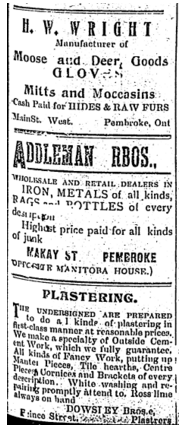
                                                       
This small ad as seen above was placed, without change, every week until a few weeks prior to the eighteenth of April, 1906 when this item appeared in the local news column of the Standard:


And their ad in the same issue of the paper reflected that change.


                                              This new site at 159 John Street is just a block east of their old location, on a side street off of Pembroke Street east, just a block down from the Queens Hotel which was located on the corner of Pembroke east and John Streets. They also kept their building on Mackay Street and were about to open another, different business at that location.
The photo below is of their building on John Street with 159 being to the left side of the building. The right side of the building was a home.


                                           I have the feeling this building, or at least their half of it, became the Addleman home. It’s reasonable to think that until they bought this building they were living in the apartments over the store on Mackay Street. There’s a large time gap between the purchasing of this building in 1906 and the publishing of the first street directory in 1925 but in that first directory all of the business concerns of Michael Addleman were listed as being at 137 Mackay Street. John Street is only listed as being a residence and in 1925  A. David, J. Michael and Michael Addleman are listed at this location. In 1927 there are, in addition to the above, Abraham D. (perhaps A. David?), Ann, Harry and Joseph all listed as living at the John Street location. Harry is listed as being a student, there is no designation for Ann (perhaps a school age child?), Abraham and Harry are listed as being clerks at M. Addleman Ltd. and J. Michael is listed as being a manager for that firm.

 The home on the right side is listed in 1925 as belonging to H.R. Mackay and in later years Edward Poupore. By 1938 the Addleman's are gone from this location and Mr. Lorne G. Fraser resides there with A.E. Marcotte living next door.

As mentioned this new location was just down the street from the Queens Hotel that was on the corner of Pembroke Street east and John Street. Once called the Metropolitan Hotel it was the finest hostelry of its day in the town of Pembroke. Below is an artist's rendition of what the hotel looked like in its prime.


But it had fallen on hard times, had been renamed the Queen’s Hotel and in 1906 at the time of Addleman Brothers moving to their new location the old hotel was poised to  become the new location for Lee Manufacturing, makers of the Peerless Incubator for the poultry industry. After Lee moved in, the sloping roof of the building was taken off to create a flat roof and in time, when Lee relocated, the building became the home of the new Superior Electric Company.  
At the time of his move to John Street. This is what Michael would have seen as he stepped out of his new business location and looked left, up John Street towards Pembroke Street.


During the period after the move the ads for the scrap business became less frequent in the paper, eventually disappearing altogether for a time until this ad appeared in 1909.


The location was the same but now Addleman Brothers had become Michael Addleman alone.
The change doesn’t seem to have affected the business as he continued to place regular ads in the paper for the next several years.
At the same time it would appear that the Mackay Street location has become Addleman's Men’s Clothing store. There seemed to be no formal announcement in the papers of the day of its opening nor were there the usual opening week specials that often accompanied the arrival of a new business. The first ad I found for the new clothing store was this one, placed in the November 4th, 1913 edition of the newspaper.


However in December of that same year there was this notice advertising their fifth anniversary sale which would put the stores opening in the fall of 1908.


Earlier, before there were any ads for this new enterprise there was this in the section for Pembroke of the 1910-1911 Ontario Gazetteer and Directory, which was a listing of businesses  by town or city:


So we know for sure that by 1910 he was in the clothing business. In the 1906 edition of the Gazetteer there was no listing for Addleman other than as a junk dealer.


After placing the two ads above there were regular weekly specials and reductions that were the hallmark of the clothing business throughout the town in those days. Although the term “Slaughter Sale” may seem almost off putting to our modern sensibilities it’s use was not uncommon in those days. 

Prosperity must have been smiling on him as on April 10th, 1913 a new, larger ad for his other businesses was drawn up and became a regular feature in the paper. The ad also heralded another change, the return to Mackay Street for all his business concerns and a new name for a new and apparently dominant facet of his business, dealing in raw hides and furs.


The location this time noted as being next door to Cecile (sic) Hotel as are the ads for  the clothing store. The Manitoba House was no more and the dominant feature of that street would have been the Windsor Hotel owned by a Mr. Moleon Cecile. In those days hotels were often referred to by the name of the owner rather than by the name of the establishment and throughout his ads at this time, and for decades to come, the Addleman business was listed as being next to Cecile’s hotel, near the C.P.R. Station. This definitely places his business in the building that became known, and is known still by the older people of the community, as Addlemans. The building still stands today and is used as an apartment building at 137 Mackay Street as seen in the photo below.


Although there are no buildings to the left of the store in this photo at the time Michael had his business here there were three other buildings between his store and Nelson Street ( called Wellington Street until the early 1920’s) seen at mid photo, left. The C.P.R. railway station mentioned in his ad would have been located approximately where the unidentified white object is at the left of the photo.

The old Windsor Hotel has long since burned and unfortunately there are no known photos of it but it was a medium sized building of two, perhaps three stories with an enclosed balcony at the front extended off the second floor. Behind it were stables that had been advertised as having room to accommodate 30 span of horses.

On the other side of Addleman's was a store that was, at different times, a tobacconist, a grocery store and a tea room. Next to it was a home and on the corner was a grocery store that eventually became a private home. 

 I should mention here that the corner grocery store was owned by a Mrs. R. Wolfe whose husband Mr. J. Wolfe also owned a grocery store in town. They were Russian Poles who undoubtedly were well acquainted with the Addleman family as they were not only neighbours and fellow business people but shared a common faith and perhaps a common language. The Wolfe’s as well as the Addleman's also adopted a child from Russia, a little girl who they brought to Pembroke and raised as their daughter. This child was one of over one hundred Jewish children who were rescued from post war Russia by Mrs. A.J. Freiman of Ottawa and brought to Canada.

As Michael stepped out of his store on Mackay street and looked across and to his right he would have seen, on the corner of Mackay and Nelson Streets, a livery business that later, with the increasing popularity of the automobile, became Fraser's Red Arrow Taxi Company and this was a constant business throughout the entire history of Addleman's on Mackay Street. The photo below, taken in 1928, is what Michael would have seen in those years.

                    
Looking to his left, across and up Mackay street he would have seen this building which was there when he came and remained unchanged throughout his time in Pembroke.


This was the Pembroke Laundry, Cleaning and Dyeing Company which not only did Pembroke and areas laundry but had it shipped in by train from as far away as Chapleau, Ontario. If the Addleman family had their laundry sent out it may have gone to this business or to one of the several Chinese hand laundry businesses that were located in town.

Now with his men’s clothing a success there were weekly ads like the one below which firmly placed Addleman's in the realm of selling inexpensive clothing for the working man.


At a time when the average working man earned less than a thousand dollars a year he would have appealed to the men who worked in many of the industries that once populated that area of Pembroke. 

One of his main competitors for the working man’s dollar in those days would have been a store run by Mr. W. Luxenburg, located at the west end of the main street who also sold inexpensive mens and boys clothing. In 1914 Mr. Luxenburg retired from the clothing business but in his place was a new competitor, a Mr. Mendel whose shop was in the heart of the business section close to all the other stores one might frequent when downtown. Perhaps this was the incentive for Michael to divert from his usual practice of placing a medium sized ad and for the first time to succumb to the lure of a full page ad in December of 1914.


And of course now, in December of 1914, the first world war had just begun. Aside from some new defence industries coming to town and an influx of men to the military base at Petawawa some ten miles west of Pembroke there was little change in the routine in the lives of the  citizens of the town or in the businesses. The newspapers of course were filled with war news and there were letters from the front written by local lads that were published fairly regularly telling what they could of the fighting in Europe and of their experiences.

As in most, if not all communities, there were drives in Pembroke and area to solicit money for the war effort and in this the Addleman family were regular and generous contributors. Below is the results of one such drive published in the paper in the waning months of the war in June of 1918. To the left of the notice you can see an ad for Addleman's who were advertising sailor hats.


As evidenced below, the donation by Michael Addleman was exceedingly generous as that $100 would be worth in excess of $1,700 in the currency of 2016.


With the ending of the war there was continued prosperity in town with most of the industries still paying “war time” wages to their employees, an issue that was to become a bone of contention in the early years of the 1920’s. However it did put extra money in the pockets of the working man and woman and the businesses of the town seemed to flourish in the continuing post war boom. 
Addleman's continued to advertise both their clothing and raw fur concerns and although it still continued to operate, the scrap business never made it to the paper.

Then in March of 1920 this notice appeared in the local papers.


Addleman's were getting out of their clothing business. There was a piece in the local news that Michael Addleman was selling his business to Mr. Charles Shore and was moving to Ottawa. He assured his customers for his other concerns he was going to continue the raw hide and fur business as well as the scrap business and these would still be located at 137 Mackay Street in the Addleman building. 

And so that spring Addleman's became Charles Shore Mens Wear.


It was apparent from the ad, seen above, that Mr. Shore was going to aim at a bit higher market than had been the case for Addleman's. This however seemed to be a bit of a hard sell to the townspeople who were used to buying cheaper priced clothes at this location. With these prices he was going up against at least two of the old, established “Gentlemen’s Clothiers” of the town, Watters & Bodell and Oak Hall Men’ Wear and was even pricing himself above the mid range stores such as Kennedy’s and Fenton & Smith and a host of other family clothing stores. This, of course, did not work as planned and almost immediately he dropped his prices and began, as many stores of the day did, accepting produce in lieu of cash. More price reductions and weekly sales ensued but it still appeared that he was struggling to lure in the customers. 

Then in July of 1921 there was a fire.


This seemed to be the final straw for Mr. Shore. There were no closing out sales, no last minute bargains, nothing but this announcement in the July, 1921 edition of the papers.
Although it is hard to read here it stated that Michael Addleman was returning to Pembroke and was going to reopen his old men’s wear store in the old location.


And as any good businessman would do he had a grand re-opening sale.


             With this Addleman's was back in the men’s wear business. The raw fur concern was still in business but ads for this were few in these years. As an established buyer of furs and hides there was probably little need to advertise what the farmers and trappers of the area already knew of and had a long relationship with. That his raw fur business was still flourishing became evident in 1925 when one of the premier manufacturing concerns in town went into receivership. The Pembroke Woollen Mills had been forced into liquidation along with a host of other woollen mills throughout the country. Canada had removed the 11 ¼ % tariff it had placed on  woollen goods coming from England and with these cheaper goods now flooding the market many local mills were forced to close. At its peak the Pembroke mill employed as many as 130 men and women and at its closing was employing 75 or 80 people adding about $60,000 to the local economy ($814,000 in 2016 dollars). In March of that year when the assets of the mill were sold off Mr. Addleman bought the entire stock of raw wool, nearly 30,000 pounds worth and was able to resell most of it almost immediately.
There was one other change around this time that had to do with the Addleman business enterprise. Like the opening of the clothing store years before this new business had no opening advertisements, indeed it never advertised at all, and would have gone unnoticed as being part of the community of stores on Mackay Street if, in 1927 it hadn’t been included in that years Mackay Street  listing in Vernon’s Directory.


Addleman's now ran a grocery store. In 1925 the listing for this store at 135 Mackay Street was Morris Barnett’s Tobacco Shop, now it was Addleman's Grocers. 
But here is another mystery that I cannot put a location to. In the 1916 edition of Vernon's Directory there was this:


So as early as 1915 Michael had, what probably was the general store that Katherine mentioned in an email to me. I have never come upon any advertising for this although for a small, family run grocery store of the day that wasn't unusual. We know that by 1906 the family, or part of it, lived and worked on John Street. We know that by 1908 the Mackay Street store was a clothing store so where, in 1916, was the grocery store located? Also I should say that in the 1925 Vernon's Directory there was no listing for grocer under Addleman and there was no Addleman listed under grocer, either wholesale or retail.

It is perhaps not surprising that Michael or one of the family decided to open (or re-open or move) a grocery store, probably in late 1925 or in 1926, just doors away from what was and had been for years, an established grocery business. One of the strange facts of business life in Pembroke was if there was a successful grocery business in an area soon other entrepreneurs would open one near by. In the case of Addleman's there was not only Gorman’s grocery but a block and a half away on the corner of Mackay and Pembroke Streets there were, within sight of one another, at least five other grocers and at least two of these were popular, long established concerns. So this was almost preordained to fail and by the next Vernon’s Directory we have which is 1929, it was gone and the store was vacant. In 1931 it was listed as Gervais’ Tea Room.
Just a note here. In the 1929 edition of the Business Gazetteer Addleman's is still listed as having a grocery as one of their business concerns but the street listing had this building, at 135 Mackay Street, as vacant. As I've discovered the business listings were often less accurate than the street listings and so I tend to believe that by 1929 and probably in 1927, the grocery business had closed.
So the grocery store at this location probably lasted but a year or two and by 1927 it was undoubtedly gone as that was the year another huge change was about to happen to the Addleman businesses.

There was this item, part of a larger ad, in the September 1st, 1927 edition of the local newspaper.


In the same issue of the paper there was this eulogy and a statement from Michael Addleman.


Now of course the advertising began and ran over a couple of months until November 3rd, 1927 this final ad for Addleman's Men’s Wear appeared in the paper.


Ever the businessman Michael had one last trick up his sleeve to lure the customers to his store. He advertised that on a particular Saturday in October he would, at times throughout the day, climb up onto the roof of his store and toss handfuls of one dollar bills to the crown below until he had disbursed all of one hundred dollars. There is no report on how this went off but I have no doubt that it drew in the crowds as any public event in those days would pull in people by the hundreds.

During all this he again began advertising for hides and fur on a more regular basis than he had done for the past number of years. 
During the war there had been a huge demand for hides which had driven up the price for which they could be sold. But at the end of the war this enormous stockpile of leather that had accumulated in the government stores was flung back onto the market depressing the price farmers were paid and which dealers could sell for. By 1927 however the price had stabilized and was back to pre-war levels and indeed now there was a shortage of hides. There was also a renewed demand for furs as the post war boom continued and after some years of few and sporadic ads for this side of their business Addleman's were once again back, full force, in the fur and hide business. The ad below is from 1928 and is a new and larger ad than had been seen for some years.


If you note the small print at the bottom of the ad states he has been in business for 25 years and this tallies with my earlier guess that he started business in Pembroke in 1904 at the time of his first advertisement. 

During the 1920's the original scrap business seems to have evolved into a more specific metal recycling business. The Vernon Directories no longer had Addleman's listed under scrap but were now listed under Iron and Steel Merchants

Then in 1929 the depression hit.
It took a year or so for the full effect of this to hit Pembroke as initially that mainstay of the local economy, the lumber industry, continued to send men to the winter camps and the mills continued to run full shifts but even these, by late 1930, were feeling the effects. By 1931 and onwards fewer and fewer men went into the bush and the mills either shuttered their operations or severely cut back the hours of operation. Most of the local industries remained open but either reduced their hours or, in an effort to keep as many men as possible employed, had two shifts of a few hours each so at least what little work there was could be divided between all their employees.
This economic catastrophe was reflected in the ads that were placed in the papers of the day. Those stores which had once placed weekly ads of a half a page or more now would place an occasional, small ad although the large, chain stores such as Friedman’s and the Canadian Department Store (Eaton’s by another name) still placed full page or two paged ads and undoubtedly helped keep the newspaper in revenue.
There was an item in the paper from this time of a farmer coming to town with a load of sheep skins for sale and after receiving an offer of ten cents per hide returned home with them as this wasn’t enough to cover his cost of bringing them to town. This drop in demand for hides of all sorts of course had to affect Michael Addleman's business and this was reflected in an almost complete cessation of any advertising. Throughout these years there were few and sporadic ads for his business except for each April, at the end of the trapping season, when an ad or two or three like the ones below were placed. The ad on the left is from 1931, the one on the right is from 1934.


  Towards the end of the 1930's the economy of Pembroke was recovering. This could be seen in the new, larger and more frequent ads that were run in the local newspaper. Their tone was more aggressive and up-beat and luxury goods were again advertised. Addleman's however had pretty well stopped placing ads altogether. In my scanning of the Standard-Observer in the late thirties there was only this one, small ad I came across, placed in the April 18th, 1937 edition of the paper.


Although I've looked through different years of the newspaper, right through until the 1950's, I never again came upon an ad for Addlemans. In the Vernon's directory they are listed right up until 1950 but in the next available edition, which is in 1960, they are gone.
In 1931 both Joseph and J. Michael Addleman are listed as living in the house on John Street with the business still on Mackay street and I would imagine that some time after the clothing store closed in 1927 Michael Addleman probably returned to live in Ottawa. By the 1941 edition there is just Joseph M. Addleman listed as manager for M. Addleman & Co. with the notation that he lives in Ottawa. 
Addleman's fur business continued on into some time in the 1950's when it ended its business concern here and in the 1960 address listings there was no longer the name Addleman listed in the directory.
From the end of the depression they still dealt in furs, still kept their store on Mackay Street open but I have the feeling it may have been open only occasionally or perhaps seasonally.
Although the last ad I could find was for the iron and steel business this side of their was never again listed in the Vernon's business directory. They were, throughout this time, still dealing in hides and furs and on a couple of occasions when I've mentioned Addleman's to some of the elderly people in town they always remember it as "the fur company."


                                                              Life in Pembroke

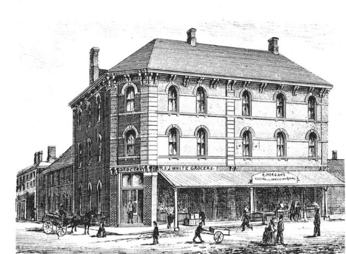
After her move to Pembroke where does Mrs. Addleman shop, lets say for groceries? In the second photograph I mentioned the brown building at the corner of Pembroke and Mackay Streets. Below is a drawing of that building and as you can see it held a fairly large  grocery store. If she didn't want to shop here she could have turned either right or left and within less than half a block been at another grocers all within easy walking distance of home. The building beside it with the steep pitched roof was a harness dealer and if Michael ever owned a horse he may have bought a harness or had it repaired here. The building beyond it was a private home and is still being used as an apartment building. 


Or she may have shopped here, at Martin's Grocery Store (as seen in 1903) of which the interior would have been typical for that time. The advent of self serve, where you roam the aisles picking items and placing them in a basket did not come to Pembroke until the mid 1920's.

                                                       
She may have, if down town shopped at Fenton & Smith's Grocery store (below, as seen in 1902) which was part of their larger department store. Here there was free home delivery of your purchases if you spent over a dollar and if you spent less, a fee of ten cents would get you the service.

                                                                      
Perhaps a new coal scuttle was needed and so after shopping at Fenton & Smith's she could have went next door to Dunlop's Hardware store. If it was winter she could have warmed herself momentarily by the stove, seen in the foreground of the photo, before having one of the clerks fetch her a new scuttle from the end wall.

                                                       
Then she might cross the street to have a quick look in Murray Brothers department store…….

                                                                 
…..up the street and a pop into Harrison's jewellers because, well, just because……


…….a glance across the street to Fraser's wondering if the kids need new shoes or scribblers for school from Grigg's…..


…….perhaps a new broom from Gardener's (note the wooden sidewalk)…..


……then down the last block, cross the bridge, go by the post office, turn left at Mackay Street and home.

As the years passed and the Addleman family prospered and became well known and undoubtedly part of the social scene of the town Mrs. Addleman may have indulged in a dress from the Ritz Ladies Wear seen here in the early 1920's.


Perhaps Mr. Addleman wanting a suit that was commensurate with his status in the town would have dropped into Watters & Bodell to have one fitted from a bolt of cloth of his choosing.


And his first car, a new Model T would have been bought from Pinks, Ford dealership


                                                                The Kids

If they were born in Pembroke or needed to visit a hospital in the first year or two after Golda arrived this hospital, the Pembroke General, run by the Grey Nuns, would have been their  only option. 

                                
However within a few years the new Cottage Hospital, seen below, was built. Generally regarded as a protestant or non-secular hospital this probably would have been the institution of choice for the Addleman family. This building is now, among other things, the home of the Upper Ottawa Valley Genealogical Group.

                                 
Living where they did there is a good chance that the children would have went to the Centre Ward Public School on Isabella Street. The school, seen below, still stands and is an office building. 

                            
Later, as they moved on to high school they would have only have to walk down  Isabella Street to the next block where the high school was located. 


A new high school was finally built in the late 1920's, too late I would imagine for any of the Addleman children to use.
Perhaps, once in the upper grades of elementary school, third or fourth book as they were called in those days, rather than going straight home they might have succumbed to the lure of Hunt's Cafe on the main street. 

                                                             
Here among the cool marble and polished glass they could have sampled the ice cream delights of the local dairies or indulged in one of Mr. Behan's  liquid concoctions.

                                                                     
And for fun. Well for the boys at least, being boys, there were two nearby train stations with regular steam locomotives coming and going, there were lumber mills and manufacturers of wooden products, a boat builder or two, carriage makers and machine shops and all this, if it were then as it was in my childhood, would be open to a couple of young boys who could wander around at will among the machinery and working men and teams of horses so long as you kept out of the way.
 Every year at least one circus came to town and when it unloaded all of its wagons from the train at the nearby C.P.R. station there was always a parade that would have went right past Addleman's store on its way to the fair grounds. What boy of any age can resist a circus and for the concerned parents it was always advertised as "good, clean fun."

In winter there was skating and tobogganing, there was a children's fair held each February and of course there were the movies. Both the Grand Opera House and the Casino Theatre ran Saturday serials to the furious playing of the piano as it kept up with the action of the silent films of the day. 
As they got older the children may have indulged in what their parents had already partaken of, and that was a summer cruise up the Ottawa River in the Steamer Oiseau. 

                           
This was such a big part of the social life of young people in Pembroke that in 1920 the stores on the main street decided to close half days on Wednesdays so their young employees could indulge in an afternoon cruise up the river to Fort William, an old fur trading post of the Hudson's Bay Co., or perhaps beyond. 

                     
All of this, the coming to Pembroke, the beginning of that humble first business and then the other businesses, the becoming part of the business community, the Jewish community and the wider community of the town, to become a widely known and respected member of the business and of that wider community who people to this day remember, all of this all took place in a time of prosperity and in a time that we can scarcely imagine. This was a time when electricity although widely available was not universal throughout the town. This was a time before television, even, until the mid 1920's, before radio was available in Pembroke and this lack of ready made entertainment at home flung people out into the wider community. There were weekly dances, there were movies that changed features three times a week, there was little theatre with local performers and there was vaudeville. The Grand Opera House had, at least monthly, a play or a minstrel programme and revues with, as the ads were always sure to point out, "lots of pretty girls." 
The depression of course changed all this but by that time the Addleman family had pretty well moved to Ottawa where I have no doubt Michael Addleman and his children were able to weather that storm and return to prosperity.
It's been fun delving into the business life and times of Michael and bringing to life, if even a little bit, his Pembroke story to his family. 

There was a mention that Michael Addleman had some connection with the Superior Electric Company of Pembroke. I could never find any connection although being a known and successful businessman he may have been on the board of directors or the fact he dealt in scrap iron and steel meant he could have been the man to whom Superior Electric had a contract with to sell their scrap metal.
 November 10, 2016


Friday, October 14, 2016

History of a Couple of Blocks

The Christie-Mary-Murray Streets Area of Pembroke

Edward "Teddy" Rowan was a well liked young man around town. He had been a good student, often making the honours list when he attended the old Pembroke High School on Isabella Street and after school, on weekends and on summer vacations he worked as a clerk in Box's Drug Store located in the old Copeland Hotel. During the summer baseball season he was also the pitcher for the Pembroke Pirates baseball team and he must have been good in that capacity as the team frequently were the winners of the town pennant while he was on the mound. Perhaps working for Mr. Box inspired Teddy to want to become a pharmacist as upon graduating from high school he applied for and was accepted into the University of Toronto's Pharmacy program. Mr. Box seemed to have influenced another young man in town, Mr. H. M. Kilpatrick, who had worked for him as well before becoming a pharmacist in his own right, opening his drug store at 153 Pembroke Street west in July of 1921. 

Over the 1923 Christmas holidays Teddy was home visiting his parents, perhaps discussing his future plans before returning to finish up his degree in Pharmacy at the University of Toronto. In the spring, after graduation, he returned to Pembroke, seemed to take the summer off and then that autumn of 1924 he opened his own business, "Teddy Rowan's New West End Drug Store" at the corner of Mary and Murray Streets. Today that first drug store  is the home of the J.C.L Systems of Hair Design at 379 Mary Street owned by Mr. Jim Lyons, a long time business man in the town of Pembroke.
Mr. Rowan was not more than a couple of years at this location when he moved his store a block north to the corner of Isabella and Murray Streets now calling his business "Rowan's Drug Store" moving into the old location of Gordon Appleby's Butcher Shop, which was originally Mr. Church's Grocery and dry good store, opened in 1887.
He took time after moving to assure the farmers of the area he still had room for them to park their horses and wagons and was prepared to treat what ailed them whether it be for man or beast. Within months of his moving his drugstore became an agent for Apex Records who distributed the records of the popular singing star of the day, Mr. Vernon Dalhart. Most of his advertising during these years centred around records and record players rather than on the drug business and to hear what he was promoting you can go on to You Tube and listen to Dalhart's recording of "The Wreck of the Old 97" among others.
He must have done well during these first years as he was able to buy he a vacant lot next to Freiman's department store (now Bob's Music) on the main street of Pembroke and on August 23rd, 1929, opened a new store at 109 Pembroke Street west that would be managed by Mr. Allan St.James while Mr. Rowan remained at the Isabella Street store. 
You can still see the remains of that drug store on Pembroke Street. As you walk by the recently closed Ottawa Valley Goldsmith stop and lift up a corner of the entranceway mat and there's the reminder of the third, of four, Rowan Drug Stores.
In years to come he changed locations once again, this time moving next door to a larger store where there is still a drug store operating today and where, for years, Rowan's Drug Store was a well known and respected fixture on the main street of Pembroke.

That little strip of stores where Rowan's began and Jim Lyons nows has his Salon was, with the surrounding area, a busy commercial section of the town at one time. After Teddy Rowan moved his store his location was taken over by Mr. M.E. Peever, barber, and next door to him a young man by the name of O.W. Risto opened a butcher shop. Risto did alright for himself as over the next few years he built a new home and shop just down the street and by late 1927 he was in his new place at 407 Mary Street where he and his heirs ran the business for decades to come. 
Around the same time as Mr. Risto moved, Mr. Peever disappeared from the scene and now, in 1928, the future home of Jim Lyons' salon became the headquarters for the International Timber Co. This company with the grand sounding name, run by Leo Allard and Lorne Tanney, was in the business of shipping Christmas trees and in that first year they did a landslide business shipping trees by the boxcar load to New York City, Chicago, Philadelphia and even by boat to far off Cuba. But the great depression was on the horizon and people were beginning to have more urgent needs than an imported tree so by the autumn of 1930 the business was gone and the store was empty.
Back when the International Timber Co. was still setting up shop Mr. James Leckie took over the location next door just vacated by Mr. Risto and opened up a grocery store, lasted a couple of years and then left, the store then being taken over, around 1931, by Mr. J. Tanney who opened a butcher shop and by the end of the decade it had been occupied for some time by the barber shop of Mr. A. Villeneuve. 
Mr. Lyons hair dressing salon was, in turn over the coming years, Mark Huot's grocery store, the first location for Chadwicks grocery store and by the mid 1950's it was the home of DeLux Dry Cleaners with Ford's Radio's next door.

If you had thought there were enough grocery stores in the area with Ristos mid way down the block and a changing venue of grocers at the end of it you'd be wrong. Right across the street from this, on the corner of Mary and Murray there was a long standing grocery business that was run in turn over these years by Lorne Tanney, Emile Sylvester, and A.A. Zeibell  and is now the home of Steve's Variety.
Then at the other end of the block on Mary street at the corner of Christie there was, in the front of the old British Lion Hotel, a grocery store run through all this time by Mr. M.T. Lawn. And if that wasn't enough in the later part of the 1920's the Dominion Store chain of grocers opened a second Pembroke location across the street taking over the restaurant run by Mr. T.P. Foran on the south west corner of Christie and Mary. When it closed some time in the 1930's it became  Mr. S.S. Costello's Meat Market and today it is an apartment block. 
To add more stores into the mix, there was, just up the block on Christie at the corner of Miller, the old grocery store of Mr. Joseph Wolfe who in 1920 sold it to Mr. Robt. Scott who in turn sold it to Mr. Ferdinand Fredrick. Mr Frederick was successful enough to expand the store to encompass two addresses, both the original 360 Christie Street and then both 358 and 360. 
Then on the south-east corner of the same intersection was the large and successful grocery store owned by Ezra Budd and of course just down the block on Miller Street was Webb's Bakery where fresh bread could be had every day but Sunday. 
If you went a couple of blocks west on Mary Street you'd come upon John Benkhe's grocery store at the corner of James Street and a block south  on Murray would take you to  Mr. Appleby's (until 1924) or walk across the street to McGaughy's grocery store and later in the decade also shop in their bakery. If you wanted a change you could have walked across Renfrew street to pick up some groceries at  Mrs. Lucas' grocery store at the corner of Hinks Street and then, since you were in the area you could scoot across Hinks and pick up a loaf of bread at Whyte's Bakery at number 224.
This competition among grocers seemed to be standard throughout the town in those days. If you saw one grocery store there was a better than even chance you could glance around and see at least one other.

On the south side of Mary Street, in an apartment at the east end of the old British Lion Hotel there was, throughout the 1920's, a shoe repair business run by Mr. L.M. LaFontaine at 406 Mary Street. By the mid 1930's as business increased Mr. LaFontaine moved his shop across the street to 405 Mary Street, directly to the east of Mr. Risto's store and remained in this location well into the 1950's. This is now the location of Court's barber shop. The only other business on the south side of the street on this block was the Pembroke Cash Coal Supply, run out of the home of J.W. Tennant at 400 Mary Street which was there for a brief time in the late 1930's.
At around the same time as Mr. LaFontaine was moving his store across the street Mr. Cyril Fortier opened a cartage business out of his new home at 399 Mary Street and at the west end of the block Mr. Tusford Labine opened an upholstery business at 411 Mary street but either moved or went out of business some time within the decade as by the late 1940's neither his business or the address at which it was listed under was there.

- written in 2016 so stores may have changed at the time you are reading this___p.l.


Sunday, September 4, 2016

Rabaul, Papua New Guinea. 


On Sunday mornings, as on most other mornings, I would walk to the far side of the island to sit on a black sand beach, swim in the warm ocean and eat a packed lunch with a book as a companion. But Sundays were special. That was when the people of the village attended church and as I walked to the beach we'd stroll along together, would exchange small pleasantries as people do, people of such different backgrounds, cultures, experiences.
 I was known in the village, it was a small place of small woven and thatched homes and the occasional one room, wood framed house strung out along the road and nestled beneath spreading mango and palm trees. In the yards bananas grew from tattered plants, chickens scratched about, goats tied to trees looked forlorn, a dog, always asleep, lay in a yard. Pigs were heard.
There was a store of sorts, the front of a home selling soda and crisps and bags of Nobby's Nuts; razor blades, feminine products, tins of cocktail sausages and a couple of t-shirts. There was a small, local hospital and clinic where one day along with the other gawkers of the village I stood outside and watched an operation through an open window. Nothing major but still, the staff were gloved and gowned and masked and worked to a chorus of owws and ahhs and staccato comments in a language not understood by me.

Everyone was dressed in their finest on Sundays, everyone but me who was on his way to a beach, and the torn shirts and worn dresses of the week were given way to carefully tended and pressed blouses and calf length skirts for the ladies and white shirts and good lap-laps for the men. Everyone carried a pair of polished shoes. 

This was a village where people ate what they grew, ate what they raised in their yards until it could be killed, ate what could be caught on a line tossed into the ocean at dusk or dawn. Work was sporadic, money was got by selling a chicken or vegetables at the market or fruit to the yacht club in the town on the other side of the peninsula. Shoes were an expense, an unneeded item except for church and after a lifetime of walking barefoot over ground soft or stoney those feet had spread and soles thickened until there was not a shoe made that would comfortably fit them. Those feet were entities in their own right, as large as a cartoon rendering and as tough as the bottom of the hiking boots I'd bought from an expedition shop selling durable footwear. And yet, there were shoes, shoes carried in the hand of every man, woman and child. They were not laced together and flung casually over the shoulder, rather they were carefully clutched together in one hand, laces tucked neatly into the shoe and swung as we walked. Or they were clutched to the chest as the precious things they were, not risking a chance at scuffs or dirt. 
We'd walk along, the people of the village and I, in silence mostly, and the mothers, like mothers everywhere fretted over the continued cleanliness of their children and glanced back occasionally at the straggling men. Then, at the edge of the village, was the church. It looked as you would expect a small church in a small village to look. It was small, white painted, shiplap wood, it had a steeple but as far as I knew, no bell. It had an upright piano in one front corner that when played was played with the clunky hesitation of an occasional musician searching for the right key. I only ever peeked inside, never stayed for a service as these seemed to go on forever in the tropical heat.
Outside, on one side of the door and beneath the shade of large trees were two benches and as each woman reached the entrance she would sit and carefully wedge one large foot after the other into her gleaming, black pumps, pumps that were made for the slender feet of city girls who never walked barefoot outside of the boudoir. Flesh puffed out of decorated cutouts, overflowed from the top and once on, the look in each lady's eyes was a mixture of pride, triumph and pain. The men too squeezed into their brogues, the opening spread as wide as it would go and the laces loosely tied. The children fretted and squirmed as their still small feet were fit into shoes they were more accustomed to wearing, they being a necessity for school. And then it was time for the service. We'd bid our good mornings and I'd walk another kilometre or so to my isolated piece of paradise and they would enter the church to hear of a paradise to come.
Once in a while I'd happen by as church was getting out and the now wilted and perspiring women would sit and unfetter their feet from the tortures of fashion and decorum with a look of heavenly bliss the minister could have only hoped for from his sermon. We'd smile at one another with the unspoken "thank heavens that's over with" floating between us.

As I said I was known in the village, known as the white man who walked by everyday on his way to a beach up the coast. I would nod,  say hello or good morning or afternoon to those whose eyes I met along the walk but that was the extent of it. Until one day when a little boy started to follow me.

There was not always a happy relationship between the original peoples of the islands and the Europeans who came to dominate those lands. The Europeans earned the riches, set the rules, made and enforced the laws and and generally lorded it over the local people who saw much of their old ways disappear and their fates held in the hands of these foreigners.
Children were rarely disciplined with physical punishment  but when the "fear of God" was needed to set them straight they were more often than not told to be good "or else the white man will come and get you" and so, children were generally afraid of white people.

The walk from Rabaul skirted along the bases of two extinct volcanoes and as it approached the far coast it passed over a small stream where women washed the family clothes in this fresh water. It was at this bridge one day that a little boy popped out of the bushes and at a good distance behind me trailed me into the village. I would occasionally turn my head and talk to him as we walked but he didn't answer and those times our eyes met he had a look akin to terror.
The next day he was there again, perhaps an act of childish bravado or of curiosity but again he tailed me along the road, through the town to the  outskirts of the village. Again, as we walked I would turn my head and talk to him and as we approached the spot where he had left me I stopped, turned and squatted down to his level. I smiled and said hello and asked his name but the fear of the white man overtook him. His eyes got large, he said something, perhaps his name, then glanced from side to side, hesitated and lit out for the undergrowth. 
The next day he was there again and walking only a few paces behind me where we could talk although it was me asking questions and him giving quiet, one word answers. The next day he again was a few paces behind me, we talked as usual but I also sensed a larger presence of many little feet and whispered voices. I stopped and turned. Directly behind me was the little boy and behind him at a further, and still safe distance, was a group of perhaps eight or ten children. The little boy smiled at me, we said hello and I asked him if these were his friends. He nodded. I said hello to the group of horror struck children, asked how they were but there were only nervous titters in reply. I said a few things and turned to resume my walk to the beach, through the village with my band of children trailing me. 
The fascination that I held for the little children was brief as over the coming days  the crowd dwindled to my usual little boy and a changing venue of friends. After a week or so of this I was on my way home one afternoon when one of the local men caught my eye, said hello and then invited me up to his house. This was relatively unheard of as there was a gulf between the races that was seldom overcome. To be invited to visit a home was a special honour and so I climbed the few steps carved out of the red dirt of the rise leading to his house and we shook hands. We sat on a bench beneath a tree and his wife brought us cool drinks from their thatched home. We introduced ourselves, talked for a bit and he told me the people of the village had been noticing me, had talked about me, I was seen as a "gutpella", a good fellow, someone who was kind to children and in this country like most others where children were loved and protected that was a high praise indeed.
We chatted a while, had a second glass of cool juice and after a half an hour or so I continued on my way to the far side of the peninsula and to the hostel where I was staying but from then on I would always stop and exchange pleasantries whenever I passed his home and he was sitting on his bench. 
And the little boy? He still occasionally walked along with me, still a step or two back and still like all children answering my questions with one word replies. I was no longer dangerous and so the excitement of being with me, even at a distance was gone and now, most days, there were better things to do.

My little piece of paradise where I went most days was a black volcanic stretch of beach that was a kilometre or so up the coast. Once beyond the village the road became a path that snaked through the palms and more or less followed the ocean to my left. I would occasionally meet people along this path, a solitary man, always carrying a machete and perhaps herding a small group of pigs to a new feeding spot or carrying a large bunch of bananas or taro tied up in a bundle for sale in the market of Rabaul. Sometimes a woman, undoubtedly younger than the years that showed on her face, carrying a trussed chicken and toting a baby, laying in the woven string bag known as a billum that was strung across her forehead and hung down her back, would pass me with a curt nod and a look of suspicion, another toddler clinging to her as they passed the feared waitman (white man). It was a path of magic to a young man raised in the coniferous wilds of the Canadian shield and the palms trees leaning out over the ocean, the alternating heat of the sun and the coolness of the dense tropical shade and the other proliferation of exotic flora gave rise to a wonderment in me. I was awe struck by the place. I had never been to a place more untouched by the modern world and its reliance on money and the status of things. It had a rhythm that, while no doubt altered by the twentieth century, still had its roots in a time of long ago and a way of life that still today was tentatively clinging to that past. 

Like so many places on the island my beach still had remnants of the Japanese occupation during the second world war. Two tilting, concrete pill boxes were the dominant feature on the broad stretch of sand and carved into the hill behind the beach was a cave that wound its way into the hillside for a good many meters. It was hard to reconcile the brutalities of that war with the tranquility of the place. What possible strategic reason could there be to occupy this island, to level the degree of brutality the Japanese showed to these people? Yet throughout the island there were rusting remembrances of that long ago war when the world came to New Britain with all the cruelty of demons bent on havoc and destruction. This lonely beach at the tip of one island in the Bismarck Archipelago, so remote and unnoticed by the world most people couldn't find it on a map, had been the scene of conquest and domination. Now on a sunny afternoon as I sat beneath a palm and watched the azure sea a small group of teenage girls appeared down the beach, yelled hello and waved, giggled and fell laughing into each others arms as they flirted with this stranger before disappearing into the forest leaving me alone with the incoming tide.

One dayI got a ride in the back of a small pick-up heading down the coast where it would drop me at the scene of another Japanese reminder of the long ago war. In the middle of nowhere the truck stopped, I got out and the driver pointed to a trail heading off into the undergrowth. A hundred yards or so later I came to another cave, this one too dug out of a hillside but bigger, big enough to hold a large boat. There was a full sized landing craft inside, set on a rail cart and poised to be pulled out, down through the jungle to the sea, a kilometre or two away, where it would have engaged the allied forces landing on the nearby beaches. But it had never been used and now for a small price a woman with the lack of a nose, it having been lost to yaws, allowed you in to walk around this piece of history. There was an elevated walkway dug into the earth and the boat now shared quarters with hundreds of bats that squeaked and fluttered around my head and as I gingerly trod through layers of bat guano alive with maggots. As I made my way around the perimeter my imagination ran riot at the effort it must have taken to construct and then have housed in that cave, this steel craft, all done in the draining tropical heat, amid privations  and the spectre of death.

I lived in a student hostel run by a church. I had a room with a bed, a desk, a chair and a brilliant over head florescent light. I don't know how I came to be staying here, that memory has gone but stay there I did in my second floor room that looked out over the grounds of the church. They served breakfast and probably an evening meal because I have no memory of ever eating any where else other than the hostel or from food sellers selling "bakes" and from The Appleteaser. The Appleteaser, my one bit of necessary decadence in what was an almost lethally, healthy life.
  At this church run residence for students and the odd wandering Canadian I don't remember ever talking to anyone there but I do remember sitting alone at the breakfast table each morning with my glass of freshly squeezed fruit juice and staring down at my bowl of fresh fruit all nicely peeled and diced in a plethora of tropical colours. There was mango, orange, paw-paw, pineapple and things unidentified but all good and wholesome, things that today I would pay a small fortune to have placed in front of me. But then, in those days i had eaten my fill of fresh fruit. I daily had pineapple sellers sell me sweet pineapple on a stick. I had spent more afternoons with chin and fingers sticky from the juice of ripe mangos of all types and sizes than I cared to repeat. I had sampled every bit of unknown exotica in the Pacific fruit world and it was all good. But at breakfast what I wanted, no, needed, was something sweet and something stimulating. I needed toast and jam and a cup of coffee or a pastry dripping with sweet icing and a coffee or a doughy cinnamon bun and a coffee. What I had was fruit. A few days of this and i was feeling ill. All this healthful living was wearing me down and I was listless and lethargic. I sat by the ocean and stared out to sea, too healthy to move, a stick of fresh pineapple hanging uneaten, limp in my hand. 
Then, one morning I wandered, depressed and tired at eight a.m., over to the yacht club to look at the boats. And there it was, the Appleteaser. It was a small coffee shop with a counter and a small table or two and was straight out of downtown (insert name of your favourite city here), air-conditioned and redolent of coffee and sweet dough. I sat at the counter, swivelled on my stool and ordered a coffee and the morning specialty, a warm, doughy, cinnamon roll with bits of apple in it. I probably had two. Instantly I felt better and the day now shone before me waiting to be embraced and explored. Just another cup of joe and I'd be off.

Then there were the bake ladies. Bakes are sold in the same basic form throughout the tropics, a wad of dough deep fried with a little something in it. There are sweet bakes with sugared dough and a few raisins  or some other bit of fruit and there are unsweetened bakes usually with a bit of fish mixed in with the dough. I discovered a bake lady on a side street in Port Moresby and ever since had been using these greasy lumps of fried dough as a general antidote to the otherwise destructively, healthy influences all around me. Still, they weren't enough to take the place of that first morning cup of coffee and a dedicated morning pastry. Now with the two of these I was ready to face the day and keep going until dusk.

One morning, filled with coffee and pastry, I was gazing out over the ocean towards a low volcano, smoking in the distance, and wondering how I could get to it when a couple of young fellows about my age happened by. They stopped and chatted and one of the things we talked about was the volcano and if visiting it was possible. A half hour later I was in an outrigger canoe being paddled by these two young men and heading across a stretch of open ocean. We landed on a rock strewn rise and climbed up an old lava flow to the sulphur crusted rim of the volcano and looked down into a caldera perhaps twenty feet or so deep with smoke coming out of the walls all around its perimeter. At the bottom was a pool of rust coloured water and tied to a large boulder and hanging down to the floor of the volcano was a massive ships rope, knotted every three feet or so.
This, I was told, was how you got in and with luck, out of this smouldering pit. The air was sulphurous and hot and after a moments hesitation I thought "Ah well. In for a penny, in for a pound", grabbed the rope and over the edge I went. The walls were hot to the touch and at each vent mounds of bight yellow sulphur had accumulated which crumbled to the touch. At the bottom the pool of water was close to boiling. I walked around, took a picture or two, saw what there was to see and then with much effort climbed the rope to the rim. The three of us walked around for a while on this desolate landscape and for a souvenir I took a lump of sulphur with me. This lump travelled with me for the rest of my trip and lasted a good few more years until bit by bit it got smaller and smaller until one day it just disappeared.
That evening I noticed the soles of my boots had cuts in them from the sharp edges of the rocks I had walked across that day and yet the two young men had walked barefoot over the same ground, had leapt from rock to rock with never a wince or trepidation as to where to put their feet. Truly testament to how tough the soles of your feet can get when used to the daily rigours of going without shoes.
Almost exactly twenty years later this smouldering volcano erupted sending a huge cloud of ash into the air, burying Rabaul and destroying the town. 

I left Rabaul and the island of New Britain one morning, flew out over the Solomon Sea, over Bougainville Island, Choiseul Island to the island of Guadalcanal and the town of Honiara. Some time later in a small single engine aircraft with a few seats I landed on a grass airstrip on an island who's name I have forgotten. Landed as men, naked except for small loin cloths leaned against long spears and watched us taxi to a halt.
But there was never an island in the South Pacific that enthralled me like New Britain. Perhaps because it was my first island of that fabled part of the world but I like to think that it was a special place, apart from all others. It is surely that in my heart.


Eulogies

Charlie

In Fond Memory of Charley Kilby

Before West Side Story and Grease turned them into soft hearted singers and dancers, before the Fonz turned them into loveable characters there were the toughs of the fifties. They were the post war rebels that ganged up, carried switchblades and brass knuckles, fought with baseball bats and bicycle chains and had wars on the streets of the cities. They were the Rebels Without a Cause and the delinquents in High School Confidential. James Dean and Marlon Brando portrayed them. Jerry Lee Lewis sang their songs.
Even Pembroke had its own rebel, Charley Kilby. He was a fixture on the downtown streets when I was growing up. Always in “uniform”, a pair of red tab, riveted Levi's rolled up at the cuffs and as tight as jeans got in those days, a white tee with a pack of smokes rolled up in a sleeve (and one fag bleeding smoke, stuck in the corner of his mouth), a black leather jacket with the collar turned up when the weather got cool and a duck tail oiled back into perfection with a pompadour on top. He was great.
 He never walked, he strolled, he sauntered swaying to his own beat at a casual pace that said “don't mess with me”. Mess probably isn't the word he would have used though. Us kids both feared and loved him. We'd often see him in the pool hall up opposite the O'brien Theatre, sometimes playing a game, sometimes just slouched against a wall watching the goings on. We of course all thought he was involved in some underworld adventure, had a moll somewhere waiting for him and was avoiding the cops. Probably he was just passing time. I have to say that for someone who looked like he'd give you the taste of a shiv if you wronged him he was good with us pests. We'd summon up the courage to go say hi, he'd grunt a reply and we'd stroll along with him past the Beamish store with the penny weigh scale and the nickel a ride mechanical horse outside, past Bailey's Sporting Goods with the giant pike hanging outside and on for a few more stores until he got tired of us and told us to scram. True to character he was pretty well monosyllabic when we did have a conversation. Questions were answered with yeah's or grunts or just a look that told you back off and you did. He wasn't a big or tall man but he had presence and was one of the characters that populated the streets of Pembroke in those perhaps not quite so innocent days.
I don't know what ever happened to Charley. Rumour was for a while he was doing serious time but nobody really knew for sure. If he's alive I hope he's enjoying his old age. If he's passed on I hope he's sitting on a lunch counter stool in that great 50's in the sky; the clacking of ivory balls in the background, Duane Eddy playing Rebel Rouser on the juke box, a smoke near at hand and a chick that looks like Mamie Van Doren coming in through the doors to meet him.

Clayton

 Television was at that in between stage back then. Not quite just a novelty, not quite totally ubiquitous. But owner or not, everyone knew and loved Lucy. My family had yet to succumb to TV, or was still saving, but either way we too loved Lucy and so once a week we'd trundle next door and spend a half hour with the neighbours watching Lucy and the gang get into and out of predicaments. 
The neighbours were the Petigrews and the two families, ours small, theirs large, would somehow cram into the darkened living room of a wartime house and together watch I Love Lucy. As wonderful as experiencing this new media was there was something even more wonderful about going to the Petigrews. That was Mr. Petigrew's ash tray. It was one of those shiny pedestal affairs but more than that, it plugged into the wall and hovering atop of it was a sleek, chrome airliner. In the darkened room, it's windows all lit up, I could almost hear the drone of the engines as it took well dressed adventurers to exotic destinations. Some times I'd be lucky enough to sit in the chair that was next to this marvel and my attention would be torn between the madcap antics of Lucy and the lure of that airplane and my imagination.
Below the airplane was a platform holding three round containers. One was the ashtray receptacle. You could rest your du maurier or Export A on this and when the ash piled up you'd press a plunger and the offending bits would be lowered and spun out of sight. Could anything ever be more sophisticated than that. 
I coveted Mr. Petigrew's ashtray and about twenty years later I thought of him and it and it's promise of adventure and exotica as I sat, sipping a drink at the Long Bar in Raffles Hotel in Singapore. The dreams of a boy sitting next to an ashtray in a darkened room had been more than fulfilled and I raised my glass and thought “Here's to you Clayton” as a Casablanca fan stirred the humid air overhead.

Kevin

Remembering a Childhood Friend, Kevin Donahue, 1949-2012
As kids, Kevin and I would often go to the Saturday matinee at the O'Brien Theatre. Then on the way home, if we had any money left we'd drop into the lunch counter in the Beamish store or perhaps go farther up the street to the lunch counter at O. Zanders Tobacco Shop and there, spend what we had left on treats. At either one of these we'd linger over our cokes and talk about whatever it is boys talk about, probably going over the highlights of the movie, how a bad guy got shot and fell off the roof  into the horse trough and how great it was that there was no kissin' until the end.
 One afternoon all we had left, after the movie and popcorn and drinks, was a dime between us, enough for one coke at the Beamish lunch counter. So in we went, sat on the red leatherette stools and drank our shared drink. As we sat there sipping the glass of coke we started to read the lunch menu posted above the grill. 
“If I had ten cents I'd get another coke.”
“If I had fifteen cents I'd get a plate of chips.”
“If I had a quarter I'd get ....” and on it went, each of us spending our imaginary money on would be food. 
“If I had sixty five cents I'd get the daily special.” We must have looked quite the pair, a couple of curly haired boys, probably with dirt on us from reliving the cowboy adventures of the movie in the back alleys of down town Pembroke or down around the boat houses by where the ferry docked and the winos hung out. 
As we were finishing, a couple of elderly women who had been sitting near by got up to leave and as they passed us they gave us a quarter each, enough for a coke and a plate of chips and told us to enjoy ourselves. Hallelujah, we'd struck gold, and latched onto a pretty neat scheme too.
After we got home we recounted to our mothers what had occurred and both of were told that it was a very kind thing the two women had done but we were never to do that again, ever...understand. We understood and that was our first and last go at larceny.
   One other time after another matinee we again romped through the back alleys of the town playing cowboys and Indians. Down town Pembroke was a boys delight in those days. There were old boat houses and train stations, a mill by the Muskrat River, stores with toy departments to explore, roofs to climb on to and then get shot off of and when all that was finished we could play under the wooden platform at the old CNR train station at the corner of Pembroke and Mackay Streets. There, with any luck we could find some change someone had dropped. Then it was onwards home. First however we had to swing on the gates of the fences along Mackay Street, zip over to Montaigne's and peek over the fence to see if we could see anyone in the pool and then rest for a bit on a bench in that little park on Mackay and Herbert Streets (the bench, by the way, is still there). 
This particular afternoon we must have lost all track of time because as we sat on the bench a car pulled up and a man yelled out the window, “You boys had better get home, the police are looking for you.”  Seems our mothers had reported us missing since we went to the show at noon and here it was after supper and we still out and about. So home we trotted where trouble was waiting for us but from then on we always made it home on time.

Friday, August 5, 2016

Sleeping at the Sailors Home


    I had spent the summer in Europe, travelling, sight seeing and by some fluke, working for some weeks in the Bavarian Alps. But that’s another story. 
    Now I had taken the overnight ferry from somewhere on the channel coast, my memory fails me here as to the port of embarkation, and had landed in the morning at Lands End in the south of England. It was early autumn and the sky was very un-English, being sunny and bright but that was more than okay. I was about to resume hitch hiking around this part of the country for a couple of weeks until it was time to leave. In early summer I had booked a flight to Singapore and I had time to kill until it came due. So I set out walking away from the ferry terminal and towards the main roadway. Here again the exact details of the day fail me. I remember getting a ride with a man in a small car and us driving through narrow roads and picturesque villages. I also remember him as having the most, foul breath of anyone I had ever met. It was a small car and he was an inveterate talker of the type that has to turn to face you with each utterance. His face, scant inches from mine would go on about the history or the nature of the region while I felt the stench of a particularly bad foundry with each sentence. He was, as I recall, a nice and courteous man and was kind to give a lift to a stranger with a large backpack but still, it is his breath that I remember and the small car that was filled with it. 
    It was perhaps the next day or it may have been later that one that I got a ride with a young man of about my own age. He was a glazier and was on his way home from doing a bit of work away from the town he was based in. He had a wife of a few months and a row house and this job. We chatted about whatever it is that young men chat about and, as we were going through the region where Stonehenge is located he detoured so I could get out to see the monument. We spent perhaps an hour there that is only in my mind as the camera I had was in my pack and I wasn’t about to go looking for it. We must have hit it off as in my old address book I still have his name, Jim Yates of number 2 Shoreham Court, The Close, Shoreham By Sea, Sussex. I remember nothing more about him other than he gave me a lift, we saw Stonehenge and I was to write him but never did. These two were the first in a series of people that would show to me the kindness of the human heart in the treatment of a stranger passing through.
    The ride that led to the title of this piece happened on an early afternoon some time around the events of the previous two rides. I honestly can’t say which rides came first but on this day I was walking along a four-lane street or roadway on the outskirts of a town. I was at the base of a small hill walking up it, turning to face the traffic with my thumb out whenever I would hear a car approaching. I turned at the sound of another car only to see a medium size bus coming towards me. I waved at the driver and as he passed hands and arms of young women waved from the windows. I waved and laughed, as I knew that this was a no-hoper. I resumed my walk up the hill and was surprised to see the bus, which had crested the hill and gone out of sight, now backing up over the same hill and stopping when it got to me. The door opened and I was invited in. It was filled with the members of a Welsh girls school and a couple of teachers who were on their way back home after competing in a choral concert. I sat on a jump seat in the well of the entrance near the door and introduced myself and in turn was introduced to the choir of the school located somewhere along the English/Welsh boarder country. We chatted and exchanged histories and stories and for a while the girls sang Welsh songs as we drove along through the countryside. The whole afternoon was one of an almost surreal experience for me. It was the stuff of impossible to believe stories. A mid twenties young man being picked up by a bus load of young women and then being serenaded by old folk songs sung in an unfathomable language as we drove through rolling green hills. For an hour or two or perhaps more we motored along, going father north and inland towards some small town where the girls and their chaperones lived at a boarding school. I knew that it was a boarding school and a religious school at that when the girls started to pester the adults to let me accompany them so I could stay there overnight. It was momentarily considered and then the spectre of the chief nun raised its head and the idea was quickly vetoed. Of course no one was more disappointed than I.
    Since a night at the school was out I decided to head for Swansea in Wales and so at the turn off to that city the bus pulled over and I said my goodbyes to the girls and watched them drive around a bend as they continued their trip home. It was also time for me to get on with the rest of this days journey as it was getting late in the afternoon and the skies were turning grey. A road sign said SWANSEA 11Km and so I resumed walking and hitch hiking. Not long after I began to walk the rain began in earnest and since a wet hitch hiker has all the appeal of a wet dog when it comes to the thought of one getting into your nice car, the hopes of my getting a ride were rapidly diminishing. Few cars passed me and none of those stopped so I walked the entire distance. 
    It was dark when I got into the city and I hadn’t a clue as to where I was or what the availability of cheap accommodations were. I stopped a man on the street to ask if he knew of any hostels or cheap B & B’s. He didn’t know of anything in the area but he stopped someone else to ask them, they asked another passer by and soon there was a small crowd of men and boys gathered around me. None of this collective brain trust could come up with any ideas of anything that suited my needs. Then someone suggested that I go to the local barbershop. The barbers apparently were a font of local knowledge and if there were any rooms to be had they would know of them. So a young boy was dispatched to take and show me the way and off we went. 
    The part of the city I had stumbled into was one of the poorer areas and so changes had been slow to take place here. The streets were narrow and winding and in general had the feeling of olde Britain, a poor and down at the heels olde Britain but still, charming to a lad from the colonies. The barbershop was a small affair from the outside, one large window with the name on it, a striped pole by the entrance and a bell that rang as the opening door hit it. I opened the door, the bell tinkled and I stepped back in time. 
    It was a small, square room, bare except for a row of seats along one wall and two antique barber chairs in the centre. An elderly client occupied each of these chairs and an even older barber tended each of these. The chairs were not the chairs that I remember from my youth that were old and the worse for wear when I was young. There were no high backs with papered headrests for when you were reclined and lathered in preparation for the razor. There were no carved hand pumps on the sides of the chairs to raise or foot pedals to lower them and they seemed to be fixed in place. There’d be no spinning around when finished, to look at the results in a mirror. In fact I don’t remember a mirror in the place although there must have been one on a wall somewhere. The chairs were clad in the prerequisite red leather and had the ornate foot rests you would expect but the backs only reached as high as mid-spine. Each customer sat bolt upright and stared at the facing wall where a large open fireplace housed a pile of grey ash, above which hung a blackened teakettle, suspended on a swinging arm. Poor lighting completed the scene and only accentuated the greyness of the place.
   The barber farthest from me stopped his work and I began to introduce myself and to explain what I wanted. I was told to speak up, as both he and his partner were hard of hearing. This turned out to be a bit of an understatement. I stepped closer and spoke up. Still I was not heard and after several attempts to make myself understood I ended up screaming into the poor mans ear. This seemed to work. I asked if they knew of a place in the area where I could get a cheap bed for the night. He turned to his partner who was still cutting hair and the two of them began a high decibel conversation. It was all I could do to keep a straight face. Eventually they seemed to agree on a place that might be suitable and the first man now proceeded to tell me what they had decided upon as though I hadn’t been able to hear them. People on the opposite side of the street could have heard them. He motioned me close and then pulling me down to him he began to yell at top volume in my ear, working I suppose, on the premise that if he couldn’t hear neither could anyone else. This done and my hearing now slightly impaired the two of them revised the instructions, again at window rattling volumes. Then again I was drawn close for the new instructions to be given and my future hearing to be yet again compromised. Through all this the two customers sat motionless, never changing their poses or expressions as the walls reverberated with the goings on. I thanked the two old men, took one last look around the shop and retreated through the door back into the damp, night air and the narrow streets. 
    The place I was looking for was a few blocks from the barbershop but was not difficult to find and within a short time I was standing in front of a two story, long, rectangular building that sat directly on the sidewalk. Two steps leading to the front door jutted into the path and these I mounted and opened the door of the Sailors Home, or as it had been called by the barber, the Home For Homeless Sailors. I entered a room, painted institutional green if I recall and which seemed to be the lounge/registration area. There was a desk in one corner, which I suppose was where you signed in and a number of chairs of varying degrees of comfort centred around a television. From these chairs faces turned to look at and a man stood to greet me. I explained to him that I was looking for a room for a night or two and this place had been recommended by the barbers. When I mentioned the barbers the mood, which had been cautiously curious now became friendly and welcoming. The two old boys seemed to be highly regarded by the residents of the home and the mere fact that they had suggested it to me and had given me instructions on how to get there seemed to be all the recommendation that I needed. I was welcomed in and was introduced to a couple of the men around the TV. I was then taken upstairs to the sleeping area and shown where I could put my stuff and which bed I could have. After stowing my gear I excused myself for a while and went out to get a bite to eat at the neighbourhood greasy spoon. When I later returned to the home the same men were in the same chairs watching the same black and white TV. I was again greeted with enthusiasm and as we stood talking watches were checked and it was noted that the pubs had now opened from the dinnertime closing hour. I had been introduced to one old gentleman when I first arrived and he now insisted that I join them for a drink at the local. I tried to beg off pleading poverty and a lack of fondness for English beer but there was no dissuading them so we set out for the pub, which it turned out, was only a few doors up the street. 
   In the nineteen eighties there was an advertisement for a brand of breaded fish sticks called Highliner and the spokesperson for this brand was a character actor who went by the name of Captain Highliner. In later years this character was slimmed down and trimmed up in response to a heightened awareness of calories and cholesterol but in the original he was a large, full bearded man made even larger by wearing a bulky, cable knit sweater. He had white hair and beard, high cheekbones and I think, smoked a pipe. This was, to a tee, the gentleman at the home. He was perhaps a bit more weathered than his TV counterpart and the beard was stained in places by the smoke from his pipe but he was the archetypical old sailor that is housed in our minds. There is a painting by one of the Weyths of a sailor on a pier that is this mythical old salt. My new found friend and potential drinking buddy could have posed for that picture, right down to the appropriate sweater.
     So with me in tow the trio of men from the home set off up the street to the local pub. There is another image that most of us carry with us of the cosy British drinking establishment, all aged wood and stained glass, the cheery publican and his wife serving drinks and dispensing chit chat to the regulars, all on a first name basis. I’ve been in such places, chatted with the bar keeps and waitresses and once or twice in a burst of camaraderie the place broke into song with most joining in. This was not one of those places. This had more in common with the “beer parlours” of protestant Ontario that were the “men’s rooms” of my youth. This was a utilitarian drinking room, a large rectangular hall, brightly lit by fluorescent tubes, it’s dingy walls housing a multitude of small Formica tables and hard, uncomfortable chairs. It seemed huge and cheerless and just after opening was already packed with men being served pints of beer by harried waiters. 
    We found a table, sat down and within moments had mugs of warm, dark beer plunked down in front of us. This was to be my first taste of beer drunk as it has been drunk in England from the earliest years, at cellar temperature, which would be warm, dark and thick to my taste buds. I sipped at it. The others quaffed and chided me for not keeping up. I made up excuses, pleaded lack of drinking expertise, told them I was used to colder, lighter beer, used the no money ploy but all to no avail. I was one of them and was expected to match them pint for pint in a contest that was sure to have me begging for mercy. Still sipping my half finished beer another round was ordered and a fresh pint was put before me. I struggled to finish the first pint, as they were finishing the second one and a third beer was placed in front of me. I told them I couldn’t afford this but was told that my money was no good, the evening was on them. I drank and listened to the stories and the gossip, the tales of being at sea on trawlers and freighters and the tales of the road told by one of the men who was a long haul truck driver now on meagre times. 
    At some point in the evening a fight broke out between two men in the centre of the hall and the waiters converged on them. There was a moment’s stand off and then the two men left by the front door. The normal hubbub of the place resumed and was scarcely broken some time later when the two men re-entered the room and strode to the table, which still held their drinks. One mans shirt was torn and both had blood on them, they were dishevelled and sweating but it seemed that what ever had caused the fight had been resolved. They stood at the table drinking the remainders of their pints then both turned and went back out the door, presumably to resume the fight. Later on they both returned to the table and sat together, blood stained and worse for wear but whatever was bothering them now out their systems. My friends had continued to order drink after drink but by now they had come to the realization that I was a lost cause as a serious drinker. With only the occasional admonishment to “drink up” I was left to my own pace, which had now crawled to a halt. At some point in the evening I begged off and left them to themselves. There were still a couple of hours until closing and I was spent. I made my way back to the home and went straight to my bed. At one point during the night I woke to use the bathroom and saw the trucker sprawled on a cot near mine. Where the rest were I didn’t know or particularly care, I was still woozy from the drink and the room spun as I made my way from the toilet to the bed where I once again passed out.
    I was wakened in the morning by my sailor friend calling me for breakfast. Light that was much too bright streamed in through the uncurtained widows that faced the street. I felt unwell, really unwell and it was only with an effort that I was able to rise and descend the stairs to the dining room. I could have used a couple of strong cups of coffee but it was weak tea that was served. Not being a tea drinker I managed to choke some down. I knew that I needed something on my stomach, if for no other reason than to have something to throw up; a case of the dry heaves had accompanied my morning ablutions. I was shaky but stable and only a little green when the breakfast meal was brought in and laid before me. My guts tightened and I fought the urge to leave immediately. The men had, out of kindness for me made a substantial breakfast of bacon and eggs and that English favourite, fried tomato. The two eggs stared up at me like great jaundiced eyes floating in a liquid slime of half cooked egg white. Greasy, fatty bacon, again barely cooked, sat beside the shrivelled slice of tomato. They stood and beamed, telling me that they felt I probably needed something to settle my stomach, all of them proud as punch at their effort on behalf of this pitiful Canadian lad. I thanked them and began to eat, each forkful was an effort to choke down but I managed to do it with liberal helpings of dried toast to sop it all up. So far so good but the day had just begun.
    I had envisioned a day of recovering in bed until noon or so and then seeing a bit of the town, taking the afternoon to recover from the abuse of the night before. The men had different ideas. I was told to hurry up and get cleaned up as it was getting on ten o’clock and the pub was soon opening. Again I tried to beg off but it was not to be and so I found myself, hung over and unwell standing in a line up of the same men from the night before waiting for the pub to open its doors. The morning sun, the bad food and the effort of staying upright suddenly caught up with me and I hurried back to the home just in time to reach the toilet and then flop on the bed for a much needed lay down. I spent the day then much as I had planned. That evening the men seemed to realize that I had years of training to go before I could ever hope to reach their feats of intake and so I was let off the hook from being one of the boys. For the next couple of days I came and went as I pleased and would join them for a beer or two in the evening. The expectation that I was a junior version of them was gone and we enjoyed each others company knowing that we were not just from different places but also from different times as well. I eventually moved on to other places and at least one other memorable morning meal but over the years I often thought of the men and in particular the old sailor. He was a kind, old man who had lived a rough life around and on the sea but whatever he had been, whatever led to his living in a home for indigent sailors he liked me and I liked him and was more than appreciative of the help and kindness that he gave. 

Eddies - A letter written to a man asking if I had photos of the old Windsor Hotel, Pembroke, or of the barber shop of that establishment.

  I don't have any photos of either the old Windsor Hotel in Pembroke or of  Eddies barbershop but I do have memories of both. As a shy young boy in the fifties Eddies was my window, my introduction to the world of men. I would go up the steps of that old hotel, walk past the reception desk and lobby where invariably sat a guest reading a paper, past the smoke shop and down the hall to the barbershop where I would enter in to one of the mysteries and delights of the adult world. 
   Here was Eddy as I remember him. A large man standing by his chair, always with a customer having  his hair cut and one or two others waiting their turn. As often as not there was one old man sitting, not wanting service, just there to pass the time of day by chatting with Eddie or with the other customers. It was not unusual in those days to have one of the waiting men to pass his turn in the chair so he could sit a while longer and talk with Eddy or the other lads of a certain age before heading home to women and chores and things to be done. Or perhaps postponing going home to a lonely room which may have been just up the stairs as the Windsor rented inexpensive rooms by the month.    
  This, to me was all a bit foreboding but enticing. I lived a “Leave It To Beaver” sort of life then, of middle class normality, of sit down suppers at the dinner table, of church on Sunday and a dog waiting at home for my return from school. A polite world where bad things never happened. 
Just entering into the hotel was, in my mind, stepping away from that world. Eddy's barbershop had the hint of cigar smoke mixed with the smells of talc and spicy aftershave that'd be splashed on his hands and rubbed on the face and neck of a freshly barbered customer. There were chairs covered in red leatherette and spittoons and a large centre table with magazines to read while you waited. Oh those magazines. These were things never seen in my home or the homes of anyone I ever knew. True Detective, True Crime, Argosy and all that ilk with lurid covers of  crime scene photos or staged scenes, invariably of a woman with the back  of one hand stifling a scream while the other fends off a man with a five o'clock shadow and lust in his heart. And the newspapers, no New York Times here. Here were more crime stories, boxing and wrestling horrors of bloodied faces and mangled bodies all printed on yellow or pink newsprint. 
There were posters on the wall of past teams for the Maple Leafs or Montreal Canadians where the players, now of legend, would be posed with the Stanley Cup. 
The ads too, for Clubman Talc and aftershave, Wildroot Hair tonic, Brylcreem – a little dab'll do ya! - and although I don't recall I hope there was at least one calendar with a picture of a pretty girl demurely displaying more of her charms than my mother would have approved.
Eddy's was the only place I have ever seen, outside of the movies, a man with his face wrapped in a hot towel, awaiting a shave. And then the preparation for that shave as the straight razor was honed to a gleam on a long leather strop, as lather was whipped up in a mug and generously applied to the face and neck of the waiting man and then the first swipe as that thin blade scraped away lather and whiskers and was wiped clean on a fresh towel draped over an arm.
I liked going to Eddy's because even though I was a boy he was never condescending, never talked to you as other than man to man. Leaving there I always felt I was one of the boys in a club I didn't understand all the rules for yet but bit by bit I was learning.
 There are three barbershops of note in my life. A small place on a back street of Swansea, Wales where Dickens would have felt at home, a chair outside on a cobbled lane in Xilitla, Mexico and Eddy's.
They say we live on until all memory of us has faded. Well, Eddie, long past on and the old Windsor Hotel, long since burnt to the ground still exist, still are there, if only in my memory.